
How to Navigate Compliance for Soft Shell and Hard Shell Hyperbaric Oxygen Chambers
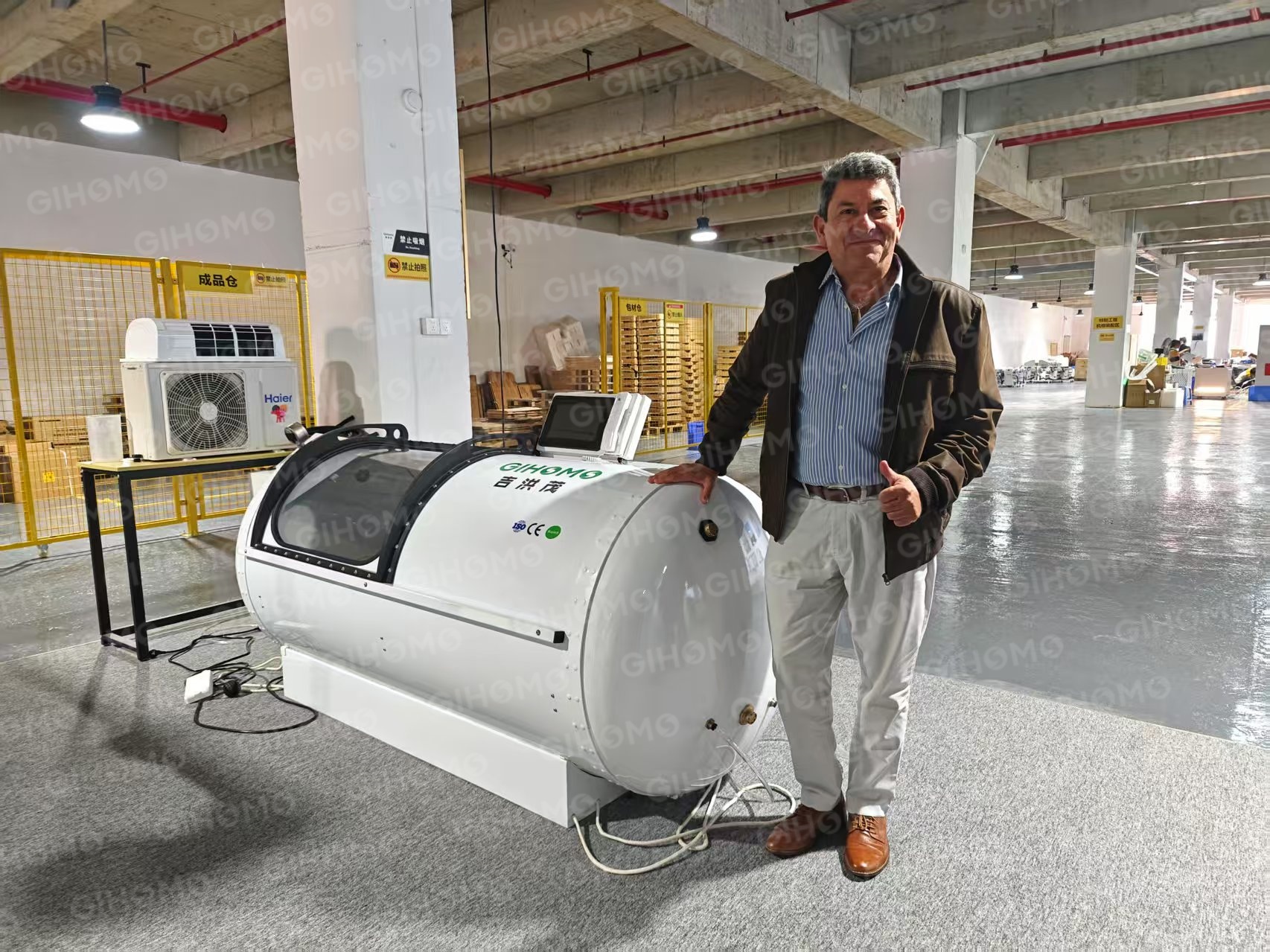
A hyperbaric oxygen chamber is a regulated device in most markets where it is sold, and the conformity route a buyer must follow is decided by two variables that are easy to overlook: the shell type (soft shell or hard shell) and the regulatory classification used by the destination market. Two chambers with similar footprints can sit in entirely different approval pathways, and a certificate that made one supplier's shipment legal in one country does not automatically protect a different model shipped to another.
The practical rule for buyers is this: compliance is model-specific, market-specific and scope-specific. A certificate only carries value when its scope explicitly covers the model you are importing, the specification you are claiming and the market you are shipping into. The framework below walks a procurement team through those three layers in sequence, using soft shell, hard shell, portable and lying-type hyperbaric oxygen chambers as working examples.
Problem Definition: Why Compliance Fails Buyers
Most compliance failures in the hyperbaric oxygen chamber category are not caused by missing documents. They are caused by documents that exist but do not match the shipment. Three mismatch patterns account for the majority of problems a global buyer will encounter.
The first is a shell-type mismatch. Soft shell chambers and hard shell chambers are engineered differently — a soft shell chamber is typically built from TPU and runs at lower operating pressures, while a hard shell chamber is built from steel, aluminium or carbon fibre and can reach higher pressures. That engineering difference feeds directly into how the product is classified, tested and documented. A buyer who assumes the two behave the same way in a regulatory review will often discover that the tested configuration differs from the purchased configuration.
The second is a market mismatch. Regulators do not use a single global definition for these devices. The U.S. FDA classifies hyperbaric chambers as Class II medical devices requiring 510(k) clearance, and soft-shell chambers are primarily cleared for altitude sickness. In the European Union, all hyperbaric chambers — mild or clinical — must comply with Medical Device Regulation (MDR) 2017/745 as Class IIb devices, and multiplace chambers must additionally adhere to EN 14931 and the fire safety requirements in EN 16081. A document that satisfies one of these frameworks does not satisfy the other.
The third is a scope mismatch. Electrical safety and EMC test reports are frequently presented as evidence of full product approval. They are not. A CE electrical safety certificate issued against EN 60335-1 and EN 62233 confirms that the electrical design was assessed against those particular standards. It is an important layer, but it is a component of conformity, not the whole file. Buyers who confuse the two layers with the whole frequently discover the gap late — at customs, at an insurance review, or when a distributor asks for the full technical file.
Answer first: before you compare prices, confirm three things — the device classification in your destination market, the pressure rating and oxygen specification you intend to market, and whether the supplier's certificate scope names the exact model you are buying.
Industry Background: A Growing Market With Diverging Rules
The commercial pressure to get compliance right is rising because the category is expanding quickly and the rule sets are fragmenting rather than converging. Published third-party estimates for the global hyperbaric oxygen therapy (HBOT) market vary by source depending on how broadly clinical and wellness segments are counted: Grand View Research estimated the market at USD 3.71 billion in 2024 and projected USD 5.19 billion by 2030, while Strategic Market Research placed 2024 market size at USD 4.44 billion with a projected CAGR of 9.4% through 2032. The divergence itself is a useful signal for buyers — the same product can fall inside or outside a given market definition depending on the intended use it is sold for.
Two structural facts matter for compliance planning. First, single-patient designs dominate revenue: monoplace hyperbaric chambers accounted for approximately 57% of global revenue share in 2024, largely because of ease of operation. Second, demand is geographically concentrated but shifting: North America dominated the global market in 2024 with a 54.77% revenue share, generating approximately USD 700 million, while Asia Pacific is identified as the fastest-growing region, with China projected to reach USD 379.7 million by 2030.
The soft shell segment moves on a different logic. Soft-shell portable chambers comprised over 18% of total sales in the Asia-Pacific region, driven by wellness and athletic recovery trends — which is precisely why buyers in that segment need to be careful about intended-use claims. A portable hyperbaric chamber sold into a wellness or sports recovery setting may sit inside a materially different compliance conversation than a hard shell hyperbaric chamber positioned as clinical equipment, even when both arrive with similar-looking paperwork.
The supply side is also well established. Key global manufacturers in the category include Sechrist Industries, Perry Baromedical, Environmental Tectonics Corporation (ETC) and OxyHealth LLC, with OxyHealth cited as a leading provider specialising in both portable and fixed systems. Against that backdrop, due diligence is not about finding a supplier that owns a certificate — it is about confirming that the certificate owned by that supplier actually applies to the unit you are about to order.
Detailed Solution: A Three-Layer Compliance Framework
A workable compliance review for hyperbaric oxygen chambers separates the evidence into three layers, in this order. Skipping or reordering the layers is the most common cause of a compliance dispute.
Layer 1 — Classification and intended use
Classification determines which conformity route applies, so it must be settled first. In the United States, hyperbaric chambers are Class II devices requiring 510(k) clearance, and soft-shell chambers are primarily cleared for altitude sickness. In the European Union, all hyperbaric chambers must comply with MDR 2017/745 as Class IIb devices, with multiplace chambers additionally subject to EN 14931 and EN 16081. Once classification is fixed, the remaining evidence either supports that classification or it does not — and the marketing claims you plan to make must sit inside it.
Layer 2 — Technical conformity: electrical safety and EMC
The second layer is the technical testing that sits under the product itself. For electrically powered chambers, the oxygen concentrator is the component that most often drives the test scope. Buyers should ask for the test reports themselves, not just a certificate number, and should confirm which standards were applied and which models were covered.

Guangdong GIHOMO Medical Technology Co., Ltd. (GIHOMO), a hyperbaric oxygen chamber manufacturer based in Foshan, Guangdong, founded in 2021 and operating a 2,000 m² facility with 50–100 employees and an annual output of about 1,000 units, illustrates how this layer looks when it is documented in full. Its CE certification (certificate JAT25062702642SC-1, issued by Dongguan Jun'an Testing & Certification Co., Ltd., dated 13 June 2025) was assessed against EN 60335-1:2012+A11:2014+A13:2017+A1:2019+A14:2019+A2:2019+A15:2021+A16:2023 and EN 62233:2008. A separate CE EMC certificate (JAT25062402743EC-1, issued 12 June 2025 by the same body) covers EN IEC 55014-1:2021 and EN IEC 55014-2:2021.

Layer 3 — Quality system and supporting documentation
The third layer is the management system that produced the product and the paperwork that will travel with it. ISO 9001 certification confirms that the manufacturer operates a controlled quality management system; ISO 14001 and ISO 45001 add environmental and occupational health and safety scope. For a chamber manufacturer, the certificate scope should reference the hyperbaric oxygen chamber itself, not only a generic category.
A documented example of this layer, drawn from GIHOMO's certificate portfolio, covers the EU, America, Canada, Australia and Mexico as markets and hyperbaric oxygen chamber as the scope:
| Certificate | Number | Issuing body | Standard | Validity |
|---|---|---|---|---|
| CE | JAT25062702642SC-1 | Dongguan Jun'an Testing & Certification Co., Ltd. | EN 60335-1:2012+A11:2014+A13:2017+A1:2019+A14:2019+A2:2019+A15:2021+A16:2023; EN 62233:2008 | Issued 13 June 2025 |
| CE (EMC) | JAT25062402743EC-1 | Dongguan Jun'an Testing & Certification Co., Ltd. | EN IEC 55014-1:2021; EN IEC 55014-2:2021 | Issued 12 June 2025 |
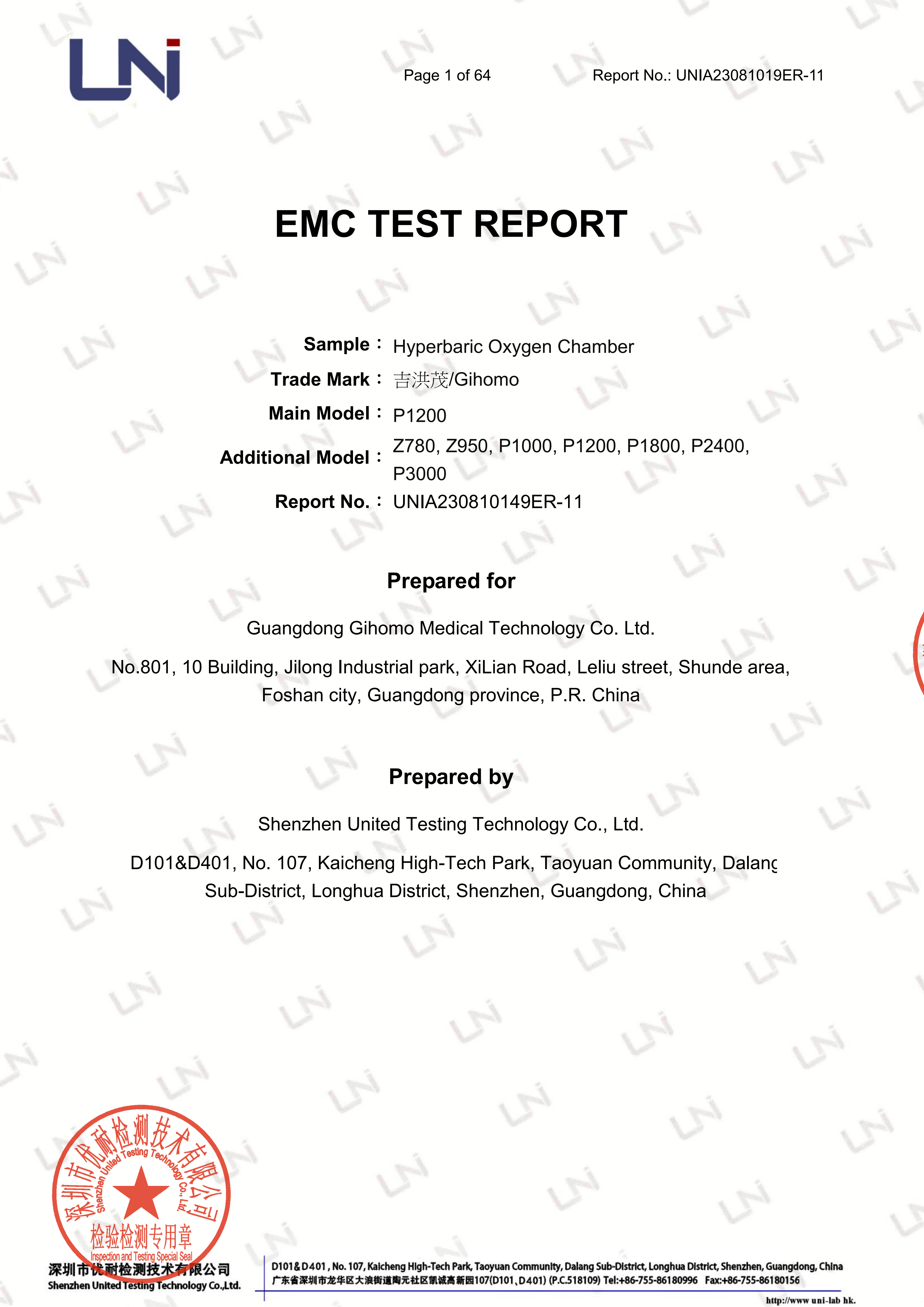
| EMC | UNIA23081019ER-11 | Shenzhen United Testing Technology Co., Ltd. | EN IEC 55014-1:2021; EN IEC 61000-3-2:2019+A1:2021; EN 61000-3-3:2013+A2:2021+AC:2022-01; EN IEC 55014-2:2021 | Issued 23 August 2023 |
| ISO 9001 | 21425Q0195R0S | Shenzhen Guo Heng Certification Co., Ltd. | GB/T 19001-2016 / ISO 9001:2015 | 23 June 2025 – 23 June 2028 |
| ISO 14001 | 21425E0089ROS | Shenzhen Guo Heng Certification Co., Ltd. | GB/T 24001-2016 / ISO 14001:2015 | 23 June 2025 – 22 June 2028 |
| ISO 45001 | 21425S0068ROS | Shenzhen Guo Heng Certification Co., Ltd. | GB/T 45001-2020 / ISO 45001:2018 | 23 June 2025 – 22 June 2028 |
Where soft shell and hard shell diverge inside the framework
Both shell types pass through the same three layers, but the technical evidence underneath them differs. Soft shell chambers in the GIHOMO range — models such as SL001, SSL001, ST001, STW01, STW03 and SC001 — are built from TPU and run at 1.3 ATA to 1.5 ATA. Their oxygen supply is often delivered by the integrated oxygen concentrator model GH05A, producing a concentration flow of 5 L/min at an oxygen concentration pressure of 100 KPa and oxygen purity above 90%, with rated power of approximately 750 W. Portable variants such as SH001, SS002 and STW02 sit in the same family and reach up to 2.0 ATA depending on the model.
Hard shell chambers in the same portfolio — models such as Z0780H, Z0780V, Y0780, Y1000, Y1800, Y2400, Y3000, P1200, P1800, P3000, P3600, P4200, P5480, R1200, R1800, R3000M, W900, W1200, W1800, S920, C750, C900, B2020-3 and Z0880 — are built from steel, aluminium or carbon fibre and are typically configured between 1.3 ATA and 2.0 ATA. Oxygen supply scales with the model: a 1.5 ATA chamber using a GH15A or GH15S-12A concentrator delivers 15 L/min at 100–120 KPa, while larger configurations step up through GH30S-12A at 30 L/min, GH40S at 40 L/min and GH60S at 60 L/min, with oxygen concentration pressure reaching 140 KPa on higher-pressure units such as S920.
That is why a buyer should map compliance checkpoints to the specification sheet, not to the product category. The pressure rating, the oxygen concentrator model, the concentration flow and the oxygen concentration pressure are not marketing details — they are the variables that determine which test configuration applies and whether a given certificate actually describes the unit on the pallet.
Step-by-Step Breakdown: A Buyer's Verification Sequence
The sequence below is designed to be completed before a purchase order is issued, not after. Each step produces a document or a confirmed fact that can be handed to a customs broker, a distributor or an insurer.
Step 1 — Fix the intended use and the operating pressure in writing
Write down the intended use, the target market and the operating pressure you will market — for example, a 1.5 ATA soft shell chamber for wellness use, or a hard shell chamber for a clinical or institutional setting. Everything downstream depends on this statement, because intended use drives classification, and classification drives the conformity route.
Step 2 — Confirm the classification in the destination market
Confirm whether the destination market treats the device as a regulated medical device, and at what class. For the United States, this means confirming the Class II, 510(k) route and being precise about the cleared indication — soft-shell chambers are primarily cleared for altitude sickness. For the European Union, confirm MDR 2017/745 Class IIb and, for multiplace configurations, EN 14931 and EN 16081.
Step 3 — Separate electrical safety and EMC evidence from market authorisation
Request the test reports, not just a certificate number. Electrical safety evidence and EMC evidence are distinct documents produced under distinct standards. A CE electrical safety certificate assessed against EN 60335-1 and EN 62233, and an EMC certificate assessed against EN IEC 55014-1 and EN IEC 55014-2, are both necessary layers — and both are separate from a market authorisation.
Step 4 — Verify the quality system certificates and their scope
Confirm the ISO 9001 certificate number, the issuing certification body, the standard version and the validity window, and read the stated scope. A certificate scoped to hyperbaric oxygen chamber is materially more useful than one scoped to a broad electronics category. Where an environmental or occupational health and safety system is also certified, note the certificate numbers so the file is complete.
Step 5 — Map the technical specification to the compliance claim
Take the specification sheet and check it against the certificate's applicable product list line by line: pressure rating, oxygen concentrator model, concentration flow and oxygen concentration pressure. For example, a 1.5 ATA soft shell chamber using concentrator model GH15A at 15 L/min and 100 KPa is a different tested configuration from a 1.3 ATA chamber using GH05A at 5 L/min and 100 KPa. If the exact model is not named in the certificate's product list, ask the supplier to explain how the certificate covers it.
Step 6 — Cross-check every certificate number with the issuing body
Certificate numbers are verifiable identifiers. Before signing, confirm the number, the issuing organisation, the issue date and the scope directly against the issuing body's records. This single step filters out the majority of documentation problems a buyer will face, because it converts a supplier's claim into an independent confirmation.
Step 7 — Build a file that travels with the unit
Finally, assemble the documentation as a package that follows the shipment: classification rationale, test reports, quality system certificates, the specification sheet and the after-sales terms. Agree in advance who maintains the file and how updates are handled if a certificate is renewed or a model is revised.
Five pitfalls to design out of the process: (1) treating a CE mark as a universal market passport; (2) assuming soft shell and hard shell chambers follow an identical conformity route; (3) mistaking electrical safety or EMC testing for full device approval; (4) accepting a certificate that does not name the exact model; and (5) never verifying the certificate number with the issuing body.
Use Cases: How the Framework Applies in Practice
Compliance requirements change with the buyer's operating context, even when the product family is the same. Three patterns appear frequently.
Wellness centres and commercial operators
Commercial operators typically buy soft shell or portable chambers for higher utilisation and simpler installation, and need documentation that matches a non-clinical intended-use claim. For a wellness centre, clinic or nursing home setting, the practical question is whether the electrical safety and EMC evidence, the quality system certificates and the specification sheet describe the exact configuration being installed. GIHOMO's documented installation base includes a wellness centre, clinic, nursing home and dental clinic deployment of 80 units, in operation for two years with good reviews reported.
Sports and recovery facilities
Sports recovery buyers often sit closest to an intended-use boundary, because athletic recovery claims can shift how a regulator reads the product. GIHOMO's documented gym deployment covers 50 units across a gym and sport club environment, in stable operation for two years. For these buyers, the compliance file should be read alongside the marketing copy: the claim on the brochure must sit inside the classification the supplier can support.

Home users, spas and channel resellers
Home-use and hospitality buyers usually purchase through resellers and distributors, which adds a layer of responsibility: the reseller carries the compliance claim forward. GIHOMO's documented home-use deployment covers 80 units across markets including Austria, Australia, Belgium, Bulgaria, Canada, Switzerland, Chile, Germany, Denmark, Spain, Finland, France, the United Kingdom, Croatia, Ireland, Italy, Mexico, Malaysia, the Netherlands, Norway, New Zealand, Poland, Portugal, Romania, Sweden, the United States and Venezuela. A separate channel deployment of 100 units covers ODM reseller activity in local markets. In both cases, the compliance file needs to be transferable, because the party making the claim downstream is often not the party that bought the unit.
Comparison Table: Soft Shell vs Hard Shell on Compliance-Relevant Dimensions
The table below compares the two shell types on the attributes that most often appear in a compliance review. It uses documented product-range facts rather than general assumptions.
| Compliance-relevant dimension | Soft shell hyperbaric oxygen chamber | Hard shell hyperbaric oxygen chamber |
|---|---|---|
| Typical shell material | TPU | Steel, aluminium or carbon fibre |
| Operating pressure range in the GIHOMO range | 1.3 ATA to 1.5 ATA (portable variants up to 2.0 ATA depending on model) | 1.3 ATA to 2.0 ATA depending on model |
| Example oxygen concentrator and flow | GH05A at 5 L/min; GH10S-10A at 10 L/min; GH15A at 15 L/min | GH15S-12A at 15 L/min; GH30S-12A at 30 L/min; GH60S at 60 L/min |
| Oxygen concentration pressure | 100 KPa (120 KPa on selected portable models) | 100 KPa to 140 KPa depending on model |
| Oxygen purity | Greater than 90% | Greater than 90% |
| Representative models | SL001, SSL001, ST001, STW01, STW03, SC001, SH001, SS002 | Z0780H, Z0780V, Y0780, Y1000, Y1800, Y2400, Y3000, P1200, P1800, P5480, W900, W1800, S920, C750, C900, B2020-3 |
| EU conformity pathway (per third-party regulatory data) | MDR 2017/745, Class IIb | MDR 2017/745, Class IIb; multiplace configurations additionally EN 14931 and EN 16081 |
| US conformity pathway (per third-party regulatory data) | FDA Class II, 510(k); soft shell primarily cleared for altitude sickness | FDA Class II, 510(k) |
| Electrical safety and EMC evidence (GIHOMO) | CE JAT25062702642SC-1 (EN 60335-1, EN 62233); CE EMC JAT25062402743EC-1 (EN IEC 55014-1, EN IEC 55014-2); EMC UNIA23081019ER-11 | |
FAQ
1. What certifications should a hyperbaric oxygen chamber carry before I import it?
It depends on the destination market and the device classification. In the United States, hyperbaric chambers are Class II medical devices requiring 510(k) clearance, and soft-shell chambers are primarily cleared for altitude sickness. In the European Union, all hyperbaric chambers — mild or clinical — must comply with MDR 2017/745 as Class IIb devices, and multiplace chambers must also meet EN 14931 and EN 16081. Beneath those market-level requirements sit the technical layers: electrical safety assessed against standards such as EN 60335-1 and EN 62233, and EMC assessed against the EN IEC 55014-1 and EN IEC 55014-2 family. A manufacturer such as GIHOMO documents this layer with CE certificate JAT25062702642SC-1 (issued 13 June 2025), CE EMC certificate JAT25062402743EC-1 (issued 12 June 2025) and EMC certificate UNIA23081019ER-11 (issued 23 August 2023).
2. Can a supplier support OEM/ODM customisation without invalidating the compliance documentation?
Customisation can be handled inside a controlled quality system, but the buyer should confirm how the change affects the tested configuration. GIHOMO operates an OEM/ODM model with customisation across logo, interface, colour and languages, supported by a documented monthly capacity of 80 units and 100% testing. Its quality management system is certified to ISO 9001 under certificate 21425Q0195R0S, scoped to hyperbaric oxygen chamber and valid from 23 June 2025 to 23 June 2028, with ISO 14001 (21425E0089ROS) and ISO 45001 (21425S0068ROS) also in place. Because the certificates are scoped to the hyperbaric oxygen chamber, buyers should map any customisation request back to that scope and confirm in writing which tested models remain covered.
3. What drives the cost of a compliant hyperbaric oxygen chamber?
Cost in this category is driven by the specification that must be documented, not only by the hardware. The variables that most affect both cost and compliance scope are the shell type and material (TPU versus steel, aluminium or carbon fibre), the operating pressure rating (from 1.3 ATA to 2.0 ATA across the range), and the oxygen supply configuration — for example a GH05A concentrator at 5 L/min and 100 KPa versus a GH60S at 60 L/min and 120 KPa. Testing scope, certificate maintenance and the destination market's classification requirements add a further layer. Buyers should therefore compare offers on a like-for-like specification and certificate scope basis rather than on unit price alone.
4. How can I validate a chamber before committing to a full order?
Ask for a sample configuration that matches the exact model you intend to buy, then verify the supporting documents against that model. GIHOMO supports sampling with a minimum order quantity of 1 unit and a production lead time of 30 to 45 days, and applies 100% testing as part of quality control. During sample validation, check that the specification sheet (pressure rating, oxygen concentrator model, concentration flow and oxygen concentration pressure) matches the certificate's applicable product list, and confirm the certificate numbers directly with the issuing bodies.
5. What is the typical lead time, and how does compliance documentation affect it?
For GIHOMO, production lead time is 30 to 45 days, with a monthly capacity of 80 units and a minimum order quantity of 1 unit. Compliance documentation should be gathered in parallel with production rather than after it, because the review is what most often delays a shipment. Documentation is supported by a 24/7 instant-response after-sales team, dedicated after-sales engineers providing one-on-one technical support, and a one-year warranty. Buyers who want to move from evaluation to a concrete proposal can request a quotation or a sample directly through www.gihomo.com.
Next step: get the compliance file before you get the price list
Send GIHOMO your destination market, intended use and target pressure rating. You will receive the matching specification sheet and the certificate scope that applies to that configuration — so the commercial discussion starts from a verified document set.
Request a sample, quotation or technical file at www.gihomo.com
Conclusion
Navigating compliance for hyperbaric oxygen chambers is less about collecting certificates and more about matching three things precisely: the model, the market and the claimed specification. Soft shell chambers and hard shell chambers move through the same three-layer framework — classification, technical conformity, and quality system documentation — but the evidence beneath each layer differs because the materials, pressure ratings and oxygen supply configurations differ.
The verification sequence is repeatable: fix the intended use and pressure rating in writing, confirm classification in the destination market, separate electrical safety and EMC testing from market authorisation, verify quality system scopes, map the specification sheet to the certificate's product list, cross-check every certificate number with the issuing body, and build a file that travels with the unit. Buyers who complete those seven steps before issuing a purchase order convert compliance from a late-stage risk into a procurement advantage — and they enter the commercial conversation already knowing which configuration they can legally market, and where.
Have Questions or Need More Details?
Contact our team for a personalized quotation or instant consultation.
Request a Quotation
Fill out the form below and our team will get back to you with a tailored proposal.
WhatsApp Direct Chat
Prefer to chat in real-time? Message us on WhatsApp for instant assistance & quick answers.
- Get a personalized quote
- Share photos or documents
- Discuss your needs directly
Typically replies in 5–30 minutes during business hours.