
Hyperbaric Oxygen Chamber for Wellness Centers & Sports Facilities: A Buyer's Guide to Room, Application, and Business Fit
Hyperbaric Oxygen Chamber for Wellness Centers & Sports Facilities: Matching Room, Capacity, and Workflow
Choosing a hyperbaric oxygen chamber is not just about pressure ratings and oxygen purity. The right fit comes from matching the device to your facility type, client profile, room conditions, supporting equipment, and daily workflow. This guide explains how to evaluate a hyperbaric oxygen chamber for wellness, sports recovery, beauty, and rehabilitation settings — and what to prepare before purchase.
Why Application Fit Becomes a Procurement Criterion
Buyers increasingly search for a hyperbaric oxygen chamber for wellness, for sports recovery, or for beauty and anti-aging services. The global hyperbaric oxygen therapy (HBOT) market was estimated at around USD 3.71 billion in 2024 and is projected to reach USD 5.19 billion by 2030, reflecting demand beyond classical clinical use. The same machine that supports a wellness center’s daily health management may be undersized for a gym’s recovery room or insufficiently comfortable for a beauty salon’s premium clientele.
For facility operators, a chamber is a long-term capital asset. It must fit the room, the operating hours, the available power supply, and the type of clients who will use it. This article translates those requirements into a step-by-step selection framework, using GIHOMO’s product line as a practical reference.
What Is a Hyperbaric Oxygen Chamber in a Wellness or Sports Context?
A hyperbaric oxygen chamber is a pressurized enclosure that allows a user to breathe oxygen at higher-than-atmospheric pressure. In wellness, sports, and beauty settings, the chamber is typically paired with an oxygen concentrator to create a mild hyperbaric environment, commonly between 1.3 ATA and 2.0 ATA.
The intended outcomes depend on the application:
- Wellness & daily health: improve sleep, enhance immunity, and support daily health management.
- Sports recovery: support rapid recovery after exercise, improve training efficiency, and support athletic performance.
- Beauty and anti-aging: promote collagen regeneration, brighten skin tone, and accelerate skin repair.
- Rehabilitation: serve as an adjunctive therapy for postoperative wound healing and other recovery protocols.
The wide range of functions explains why the same equipment category appears in gyms, wellness centers, med-spas, rehabilitation clinics, and even dental clinics.
Key Decision Factors Before You Buy
Before evaluating specific models, clarify four conditions: the facility type, the room environment, the supporting equipment, and the operating pattern. These four factors determine whether a chamber will deliver a good return on investment.
1. Facility Type and Client Profile
Different facilities use chambers for different purposes. A wellness center may use an 80-unit deployment model for daily health management. A gym may install a chamber for post-training recovery and member retention. A beauty salon or spa may position a chamber as an anti-aging service that complements facials and body treatments. A rehabilitation center may prioritize accessibility, such as a wheelchair-friendly chamber.
The client profile affects capacity: a one-person chamber with a sofa may suit a boutique spa, while a two-person or four-person hard shell chamber may be necessary for a high-traffic commercial facility.
2. Room Size and Ventilation
Hyperbaric oxygen chambers are designed for indoor, cool, and ventilated environments. This is not an optional preference. A chamber placed in a small, poorly ventilated room, or in a space without adequate cooling, will create discomfort for clients and can affect equipment stability during long sessions.
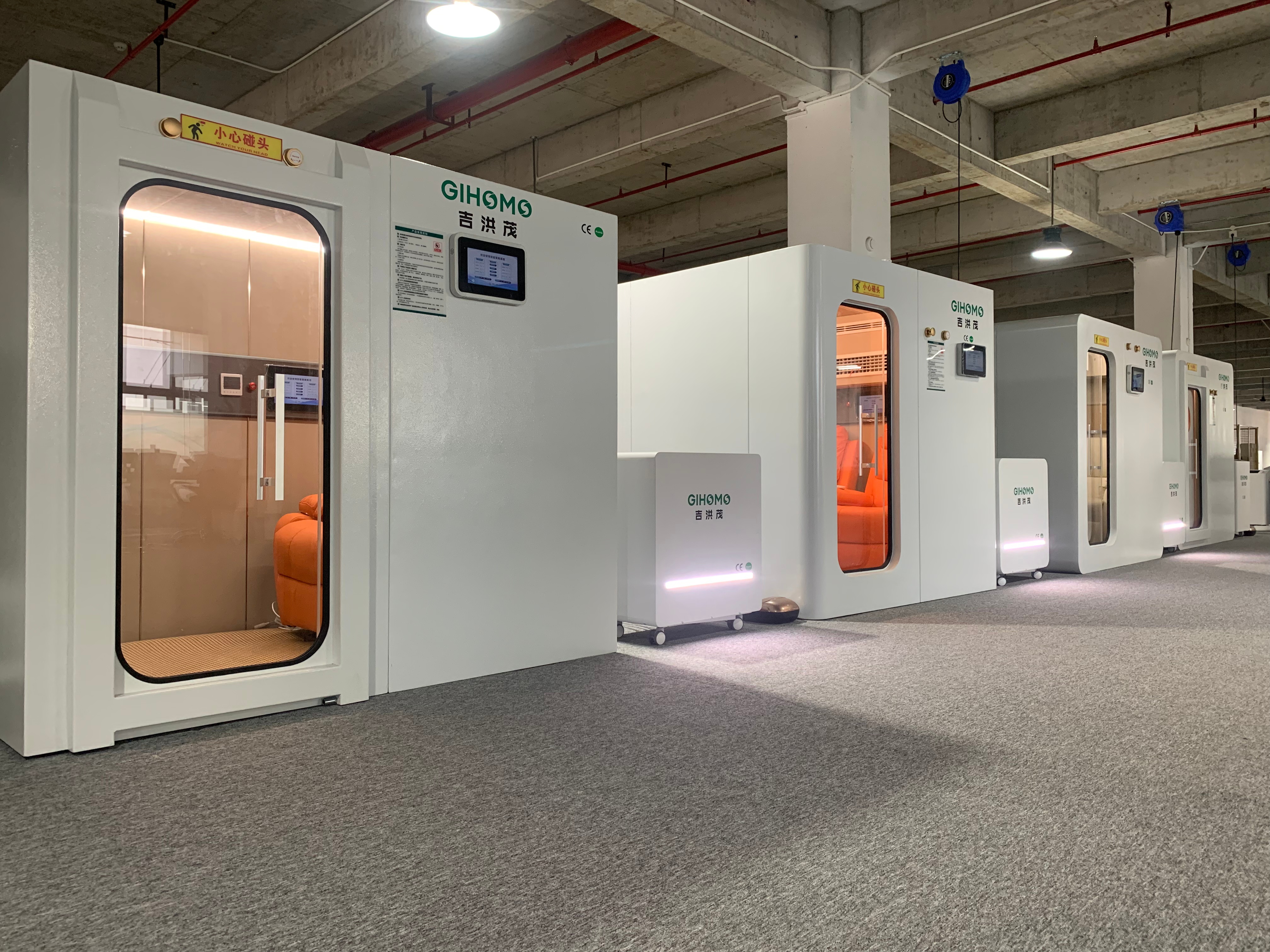
Measure your room before shortlisting models. Chamber sizes in GIHOMO’s range vary from compact soft shell units to multi-person steel chambers:
- Soft shell and portable models: chamber sizes from approximately 1700×1100×1200 mm to 1900×920×1500 mm.
- One-person hard shell models: approximately 1350×780×1880 mm to 2200×1200×1900 mm.
- Multi-person models: approximately 2200×1800×1900 mm up to 2200×5480×1900 mm for eight-sitter configurations.
3. Supporting Equipment
A hyperbaric oxygen chamber does not work alone. GIHOMO specifies that its chambers require supporting equipment including:
- A water-cooled air conditioner
- A 24V power supply
- An oxygen concentrator
- Two manual pressure relief valves
- Automatic pressure relief valves
These components support safe pressurization, comfortable internal temperature, emergency pressure release, and consistent oxygen supply. Buyers should confirm whether the chamber package includes the concentrator and conditioner or whether these must be purchased separately.
4. Operating Mode
Most commercial chambers are designed for 24/7 operation. This matters for wellness centers, gyms, and spas that operate early mornings, evenings, and weekends. If your facility plans to run multiple sessions per day, select a chamber and supporting system rated for continuous use.
Soft Shell vs. Hard Shell: Which Fits Your Facility?
One of the first decisions in the buying process is chamber construction. Both soft shell and hard shell chambers can be used in wellness and sports settings, but they fit different operational profiles.
| Factor | Soft Shell / Portable Hyperbaric Chamber | Hard Shell Hyperbaric Oxygen Chamber |
|---|---|---|
| Typical material | TPU | Steel, aluminum, or carbon fiber |
| Typical pressure | 1.3–2.0 ATA depending on model | 1.3–2.0 ATA depending on model |
| Floor space | Compact, easier to fit in smaller rooms | Requires more floor space |
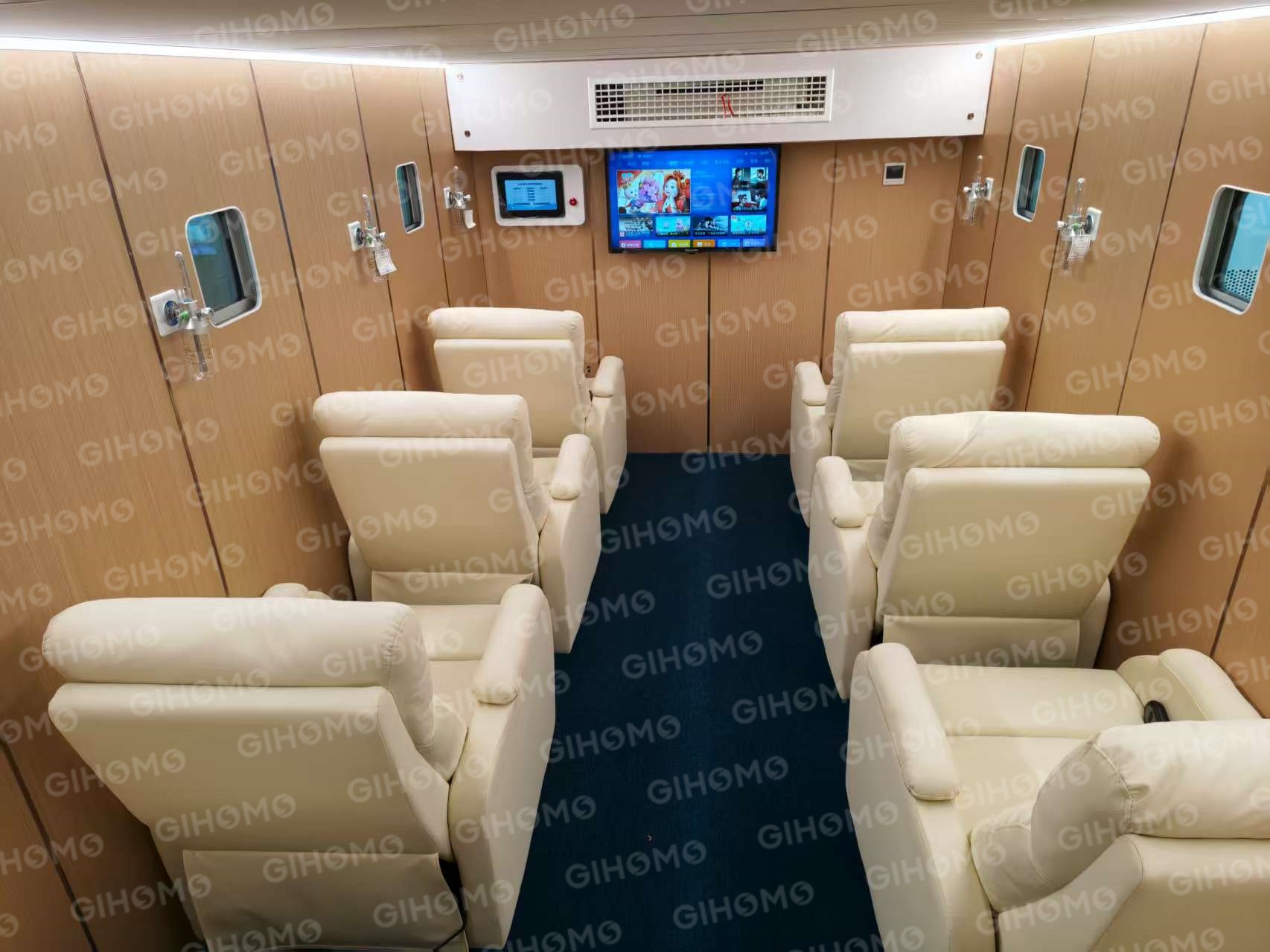
| Interior configuration | Simpler interior, often lying or sitting type | Sofa, reclining sofa, TV, interior decoration, carpet, lighting, call bell |
| Typical users | Home users, small studios, early-stage wellness facilities | Wellness centers, gyms, clinics, spas, commercial facilities |
| Portability | Lightweight; some models weigh about 20–25 kg | Stationary installation |
Soft shell models are frequently described as portable hyperbaric chambers. For example, GIHOMO’s SSL001 soft shell chamber has a net weight of about 24.5 kg, while the SL001 lying type soft shell chamber weighs about 20.5 kg. These units are easier to move and can fit into smaller rooms or temporary spaces.
Hard shell models, by contrast, are built for sustained commercial use. They include standard features such as fixed or adjustable sofas, oxygen outlets, soft interior decoration, carpet, lighting, and call bells. Many models also offer optional water-cooled air conditioners and TV sets, which improve the client experience during 60- to 90-minute sessions.
Choosing by Application Scenario
Hyperbaric Chamber for Wellness Centers
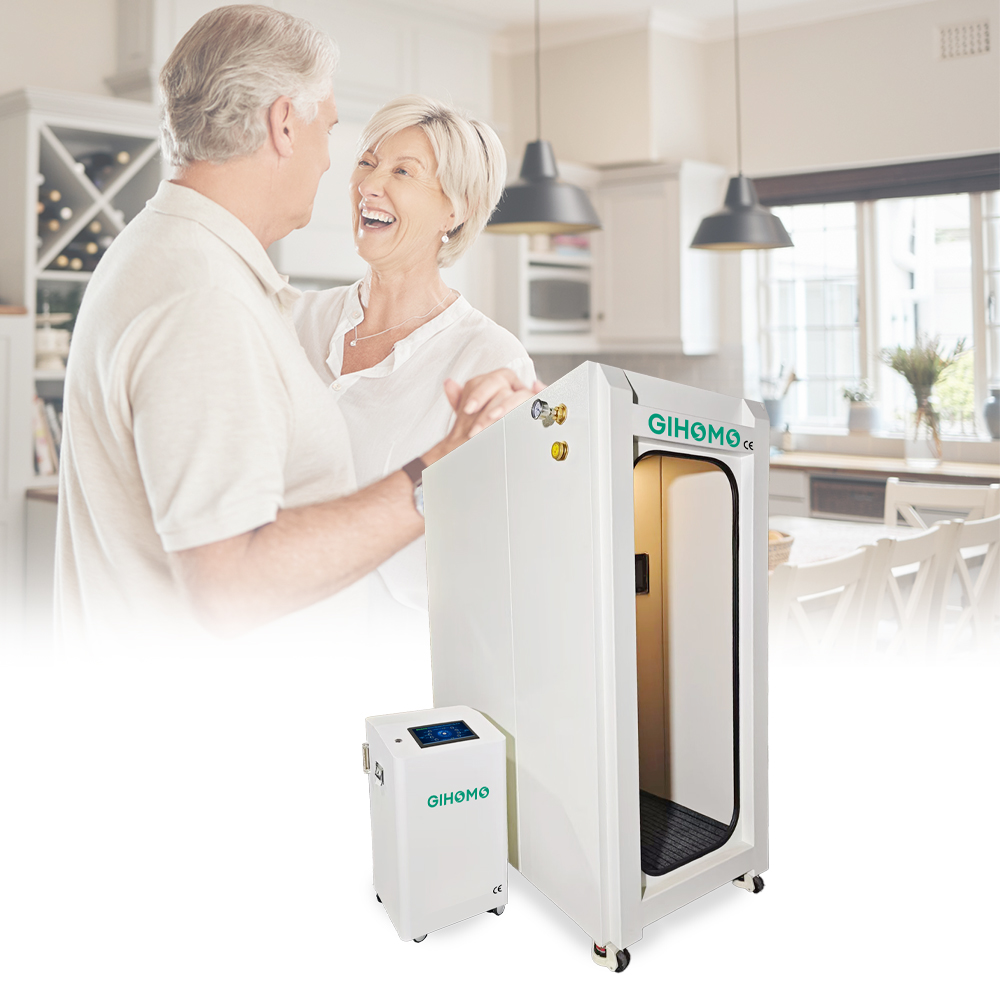
In health care and wellness applications, the chamber’s role is to improve sleep, enhance immunity, and support daily health management. Wellness centers often choose one-person hard shell chambers such as the GIHOMO Z0780H, R1200, or W900, especially when the chamber becomes a signature service.
A water-cooled air conditioner becomes important because a client may remain inside for 60 minutes or more. The combination of a comfortable sofa, soft lighting, and a TV set helps create a relaxing experience that supports repeat visits.
Hyperbaric Chamber for Sports and Gym Use
Athletes and gym members use HBOT for rapid recovery after exercise, improved training efficiency, and enhanced athletic performance. In a gym setting, a chamber should be located near recovery areas, and the surrounding environment must remain cool and ventilated.
Gyms often prefer models that are easy to supervise. A one-person hard shell chamber with clear interior visibility or a soft shell model with a transparent structure can work well. For high-traffic facilities, larger models such as the P3000 or Y3000—which accommodate four people—may increase member throughput.
Hyperbaric Chamber for Beauty Salons and Anti-Aging Services
In beauty and anti-aging applications, the chamber’s function is to promote collagen regeneration, brighten skin tone, and accelerate skin repair. These claims matter commercially because they give spas and salons a new service category with high perceived value.
For a beauty salon, aesthetics play a role in equipment selection. A chamber with a polished exterior, soft interior lighting, and a comfortable reclining sofa creates a more premium impression. GIHOMO offers customization options including logo, interface, color, and languages under its OEM/ODM service, which some beauty brands use to align the equipment with their visual identity.
Hyperbaric Chamber for Rehabilitation
Rehabilitation settings may require more specialized configurations, including wheelchair-accessible models. GIHOMO’s product range includes wheelchair hyperbaric chambers and lying-type chambers, which suit clinics serving patients with limited mobility. In these settings, supporting equipment and safety features such as automatic pressure relief valves and call bells are essential.
Step-by-Step Selection Process
Use the following workflow to select the right hyperbaric oxygen chamber for your project.
- Define the core application. Write down whether the chamber will be used for wellness, sports recovery, beauty/anti-aging, rehabilitation, or a mix.
- Estimate daily capacity. Calculate how many sessions you plan to run per day and how many people need to be treated simultaneously. This determines the number of seats and whether you need multiple chambers.
- Measure the installation room. Confirm the room can accommodate the chamber dimensions with enough clearance for maintenance and emergency access. Confirm the room is indoor, cool, and ventilated.
- Check power and supporting equipment. Verify the availability of a 24V power supply, the recommended oxygen concentrator, and space for a water-cooled air conditioner. Plan for two manual pressure relief valves and automatic pressure relief valves as part of the safety system.
- Match pressure to service positioning. Decide whether 1.3 ATA, 1.5 ATA, or 2.0 ATA is appropriate. Higher-rated models such as 2.0 ATA chambers may support different marketing claims, but the operator must follow all applicable regulations.
- Evaluate comfort features. For commercial use, prioritize sofas, lighting, call bells, air conditioning, and entertainment options that increase client comfort.
- Confirm certification and after-sales support. Ask for CE, FCC, or other certifications relevant to your market, and confirm the supplier’s warranty and technical support structure.
- Request a quotation or sample configuration. Send your room size, application, and capacity requirements to the manufacturer to receive a recommended model list.
Use Cases and Evidence
Wellness Center
A wellness center and related health facilities in North America and Europe purchased 80 units over a two-year period for applications including sleep improvement, immunity enhancement, and daily health management. The equipment operated stably during that period, with buyers highlighting low price, safety, efficiency, and comfort as key decision factors.
Gym and Sports Club
A gym buyer in a similar market purchased 50 units over two years for gym use and sports club recovery services. The operation result was stable operation, with the buyer emphasizing unique design, safety, efficiency, and comfort.
Beauty Salon and Spa
A beauty-salon-and-spa buyer purchased 30 units over two years for use in beauty salons, spas, and hotels. The buyer described the cooperation as a win-win, highlighting unique design, safety, efficiency, and comfort. This case shows that design and comfort can matter as much as technical specifications in the beauty segment.
ODM Reseller
An ODM reseller purchased 100 units over two years for sale in local markets. This purchase pattern suggests that some buyers do not operate the chambers themselves, but resell them under their own brand. For those buyers, OEM/ODM capabilities—logo customization, interface, color, and language options—are critical.
Certifications and Compliance Considerations
Regulatory requirements differ by market. In the US, the FDA classifies hyperbaric chambers as Class II medical devices requiring 510(k) clearance, and soft-shell chambers are primarily cleared for altitude sickness. In the EU, hyperbaric chambers must comply with Medical Device Regulation (MDR) 2017/745 as Class IIb devices, and multiplace chambers must adhere to EN 14931 and fire safety requirements in EN 16081.
GIHOMO states that its core products have obtained certifications including CE and FCC. Buyers should verify which certifications apply in their destination country and ensure the manufacturer’s documentation matches their intended use case. Certification requirements may also influence whether a buyer selects a mild or a clinical configuration.
Popular GIHOMO Configurations by Facility Type
| Facility Type | Recommended Model Type | Typical Pressure | Key Features |
|---|---|---|---|
| Boutique spa / beauty salon | One-person hard shell, Z0780-series or R1200-series | 1.3–1.5 ATA | Fixed sofa, soft decoration, lighting, call bell, optional TV / water-cooled AC |
| Wellness center / clinic | One-person or two-person hard shell with BIBS system | 1.3–1.5 ATA | Reclining sofa, oxygen outlet, interior decoration, carpet, call bell |
| Gym / sports club | Four-person hard shell, P3000 or Y3000 | 1.3 ATA | 4 sofas, 4 oxygen terminals, wireless intercom, water-cooled AC |
| Rehabilitation center | Wheelchair-accessible or one-person adjustable sofa model | 1.3–1.5 ATA | Accessible layout, adjustable sofa, call bell, safety relief valves |
| Home wellness | Soft shell / portable model | 1.3–1.5 ATA | Compact footprint, lower weight, easy operation |
Room Preparation Checklist
- Indoor, cool, and well-ventilated room with enough clearance around the chamber.
- Stable power supply matching the concentrator’s rated power (for example, about 750W to 1500W for many single-person systems).
- Space for the oxygen concentrator and water-cooled air conditioner.
- Access for installation and future maintenance.
- Staff trained on pressurization, emergency pressure release, and cleaning protocols.
- Operating plan that respects 24/7 capability and scheduled maintenance windows.
FAQ
Q1. What certifications should I check before buying a hyperbaric oxygen chamber for commercial use?
Certification requirements depend on your market. In the US, hyperbaric chambers are Class II medical devices requiring FDA 510(k) clearance; soft-shell chambers are primarily cleared for altitude sickness. In the EU, chambers generally need to comply with Medical Device Regulation 2017/745 as Class IIb devices. GIHOMO states that its core products have obtained CE and FCC certifications. Always request the certification documents for the exact model you plan to buy and confirm they match your destination country and intended use.
Q2. Can a hyperbaric oxygen chamber run continuously in a busy wellness center?
Yes. GIHOMO specifies that its hyperbaric oxygen chambers operate in 24/7 mode. This makes them suitable for wellness centers, gyms, and spas with long operating hours. However, continuous operation depends on correct installation, adequate ventilation, and supporting equipment such as a water-cooled air conditioner, an oxygen concentrator, and properly maintained pressure relief valves.
Q3. Which chamber should a sports facility choose for athlete recovery?
A sports facility should choose a chamber that fits its member volume and recovery workflow. Smaller gyms may start with a one-person hard shell chamber or a soft shell portable chamber. Larger sports clubs may prefer a four-person model such as the GIHOMO P3000 or Y3000, which includes four sofas, four oxygen absorption terminals, a wireless intercom, and a water-cooled air conditioner. The room must remain cool and ventilated because the facility intends to support rapid recovery after exercise.
Q4. What supporting equipment do I need to prepare for installation?
GIHOMO specifies required supporting equipment including a water-cooled air conditioner, a 24V power supply, an oxygen concentrator, two manual pressure relief valves, and automatic pressure relief valves. These components support client comfort, safe pressurization, oxygen delivery, and emergency pressure release. Confirm with the supplier which items are included in the package and which must be sourced separately.
Q5. What is the typical lead time for a wholesale hyperbaric chamber order?
Lead time depends on configuration and volume. As a reference, GIHOMO states a lead time of 30–45 days for OEM/ODM orders, with a monthly production capacity of about 80 units and a minimum order quantity of 1 unit. For a project-specific timeline, request a quotation with your chamber model, customization needs, and delivery destination. You can send your room layout and application details to GIHOMO for a recommended configuration and lead-time estimate.
Conclusion: Buy for Your Operation, Not Just for the Product
The right hyperbaric oxygen chamber for a wellness center, gym, spa, or rehabilitation facility is the model that fits your space, your client flow, and your service model. Soft shell and portable chambers offer flexibility and a lower entry barrier. Hard shell chambers offer comfort, durability, and the interior features that support premium session experiences.
Before purchasing, verify your room conditions, plan your supporting equipment, calculate daily capacity, and confirm certifications for your target market. A chamber that matches your operation will generate more consistent sessions, fewer maintenance issues, and a stronger return on investment.
Get a Configuration Recommendation
Send your facility type, room dimensions, and daily session targets to GIHOMO for a model recommendation, quotation, and lead-time estimate. GIHOMO supports OEM/ODM customization and provides one-on-one technical support for commercial buyers.
Email: gihomo@hotmail.com | WhatsApp: +852 68176191
Have Questions or Need More Details?
Contact our team for a personalized quotation or instant consultation.
Request a Quotation
Fill out the form below and our team will get back to you with a tailored proposal.
WhatsApp Direct Chat
Prefer to chat in real-time? Message us on WhatsApp for instant assistance & quick answers.
- Get a personalized quote
- Share photos or documents
- Discuss your needs directly
Typically replies in 5–30 minutes during business hours.