
Hyperbaric Oxygen Chamber Supplier Evaluation FAQ: Capability Verification & Delivery Assurance
Hyperbaric Oxygen Chamber Supplier Evaluation FAQ: Capability Verification & Delivery Assurance

A 1.5 ATA one-person hyperbaric oxygen chamber. The pressure rating is only one of five specifications that must be verified before a purchase order is released.
Most hyperbaric oxygen chamber purchases fail in one of two places: a capability claim that was never verified, or a delivery commitment that was never written down. Price and headline pressure get the attention; configuration fit, oxygen chain sizing, certificate scope, production scheduling and acceptance criteria decide whether the chamber is usable when it arrives.
This FAQ-style evaluation guide answers the questions buyers actually send during supplier screening. Model specifications, certificate numbers and production terms from Guangdong GIHOMO Medical Technology Co., Ltd. (GIHOMO) are used as worked examples of what a verifiable answer looks like — not as a substitute for your own document checks.
GIHOMO is a Foshan, Guangdong-based manufacturer of hard shell and portable hyperbaric oxygen chambers, founded in 2021, operating under an ISO 9001 quality management system and exporting to EU and USA markets. Its catalogue spans soft shell, portable, one-person and multi-person hard shell configurations, which makes it a useful reference set for the verification questions below.
Short answer: screen a hyperbaric oxygen chamber supplier against five gates before discussing price — (1) configuration fit, (2) pressure and oxygen-chain basis, (3) certificate scope rather than certificate presence, (4) capacity and lead-time evidence, and (5) written acceptance criteria. A supplier that can answer all five with documents is a candidate; one that answers with adjectives is a risk.
Problem Definition: Why Chamber Purchases Fail After the Quote
A product listing is a description, not a commitment. A catalogue can tell you that a model exists; it cannot tell you that the unit in your order will be built to that specification in the month you need it, wired for your voltage, documented for your market, or accepted by your engineer on arrival. The gap between the two is where most procurement disputes are born.
Three specific gaps cause most of the damage:
- Pressure-basis ambiguity. A stated ATA value may be a maximum rating or a working pressure, and may be expressed as absolute or gauge pressure. Two suppliers quoting "1.5 ATA" can be quoting different things.
- Certificate versus authorization. Electrical safety, EMC and CE documentation are frequently presented as if they answered a medical-device market-access question. They do not. GIHOMO's own material describes CE, FCC and EMC certification claims, and those claims still need to be matched to specific models, issuing bodies and scopes.
- Capacity versus free capacity. A monthly capacity figure says what a plant can produce, not what is uncommitted in the week your order lands.
Safety documentation belongs inside this list, not after it. The U.S. Food and Drug Administration has reported fires involving hyperbaric oxygen therapy devices that resulted in serious injuries and deaths, and advises providers to review and follow the manufacturer's instructions for use for each device and to maintain fire-prevention measures. That makes oxygen management, internal electrical design and pressure-relief documentation part of the purchase specification. GIHOMO states that its chambers use continuous oxygen-level monitoring, oxygen delivery through a mask, and 24V DC internal electrical components — claims that should be converted into schematics, alarm-threshold documentation and electrical test reports during evaluation.
Industry Background: What Changed the Evaluation Criteria
The commercial context explains why supplier screening has become more structured. Mordor Intelligence valued the global hyperbaric oxygen therapy market at USD 7.43 billion in 2025 and projects USD 10.55 billion by 2031, a CAGR of 6.03%. Growth of that shape pulls new buyers into the category — wellness operators, sports facilities, spas, clinics and resellers — many of whom are buying their first chamber and have no internal benchmark.
Those buyers land in two very different segments. Harvard Health Publishing distinguishes evidence-based uses of hyperbaric oxygen therapy from unproven claims, and that distinction maps directly onto procurement: a chamber positioned for FDA-cleared medical indications is evaluated on regulatory pathway and clinical documentation, while a chamber positioned for wellness or sports recovery is evaluated on configuration, comfort, throughput and electrical safety. The peer-reviewed literature describes therapeutic effect in conditions such as decompression sickness, arterial gas embolism and carbon monoxide poisoning; the mechanism itself — breathing oxygen at higher than normal pressure inside an enclosed space — is consistently defined across major medical institutions.
The pressure landscape is equally important to understand before comparing quotes. Soft shell chambers are generally described as operating at mild pressures, usually around 1.3 ATA with a practical ceiling near 1.4–1.5 ATA, while hard shell clinical chambers typically operate between 2.0 and 3.0 ATA and multiplace systems can reach 6.0 ATA. In the United States, a full-body hyperbaric chamber is a Class II device classified under 21 CFR 868.5470 with product code CBF, and FDA clearance through the 510(k) process governs medical claims. None of this makes a high-pressure listing wrong — but it does mean that a pressure number without a definition and a test report is not yet a specification.
Detailed Solution: Five Verification Gates for a Hyperbaric Oxygen Chamber Order
Gate 1 — Configuration fit: form factor, occupancy and footprint
Configuration is the first filter because it determines everything downstream: room size, power budget, staffing model and price band. GIHOMO's catalogue illustrates the range a single supplier may cover, and also why you must specify before you compare.
- Sitting soft shell: STW01 is a sitting type soft shell chamber in TPU at 1.5 ATA with a 1820mm × 820mm × 1500mm chamber; SC001 and ST001 are sitting type soft shell chambers at 1.3 ATA.
- Lying soft shell: SL001 is a lying type at 1.3 ATA with a D2200mm × 800mm chamber and a 20.5 kg chamber weight, using interior and exterior display panels; STW03 is a lying type at 1.5 ATA with a D1000mm × 2350mm chamber; SSL001 is a 1.5 ATA soft shell chamber at 1700mm × 1100mm × 1200mm with a 24.5 kg chamber weight.
- Portable: SH001 is a lying type portable chamber at D800mm × 2000mm in TPU; SS002 is a two-person portable chamber at 1600mm × 1200mm × 1300mm; STW02 is a portable chamber with a BIBS system at 1900mm × 920mm × 1500mm.
- One-person hard shell: Z0780H (steel, 1350mm × 780mm × 1880mm) and Z0780V (steel, 1.3 ATA) for compact single-occupancy rooms; Z0880 at 880mm × 1750mm × 1880mm for a narrower footprint.
- Two- to four-person hard shell: Y1800 (two persons, 2200mm × 1800mm × 1900mm, touch screen with a six-language smart system), Y2400 (three persons), Y3000 (four persons, 2200mm × 3000mm × 1900mm).
- Multiplace: P3600 (six seats), P4200 (eight seats at 1.3 ATA), P5480M (eight chairs with eight oxygen outlets and a BIBS system).
- Lying type hard shell: C750 (Φ750mm × 2100mm) and C900 (Φ900mm × 2100mm), both aluminium at 2.0 ATA; S920 is aluminium at 1.8 ATA with a BIBS system.
- Material alternatives: B2020-3 is a carbon fibre hard shell chamber at 1.5 ATA with an outer size of 2300mm × 1400mm × 1700mm and an inner size of 2100mm × 1100mm × 1350mm.
Ask the supplier to confirm the configuration against your room drawing, door width, floor loading and ceiling height, and to state the chamber weight where relevant. A soft shell chamber weighing roughly 20 to 25 kg and a steel multiplace room are different installation projects, not different prices for the same product.
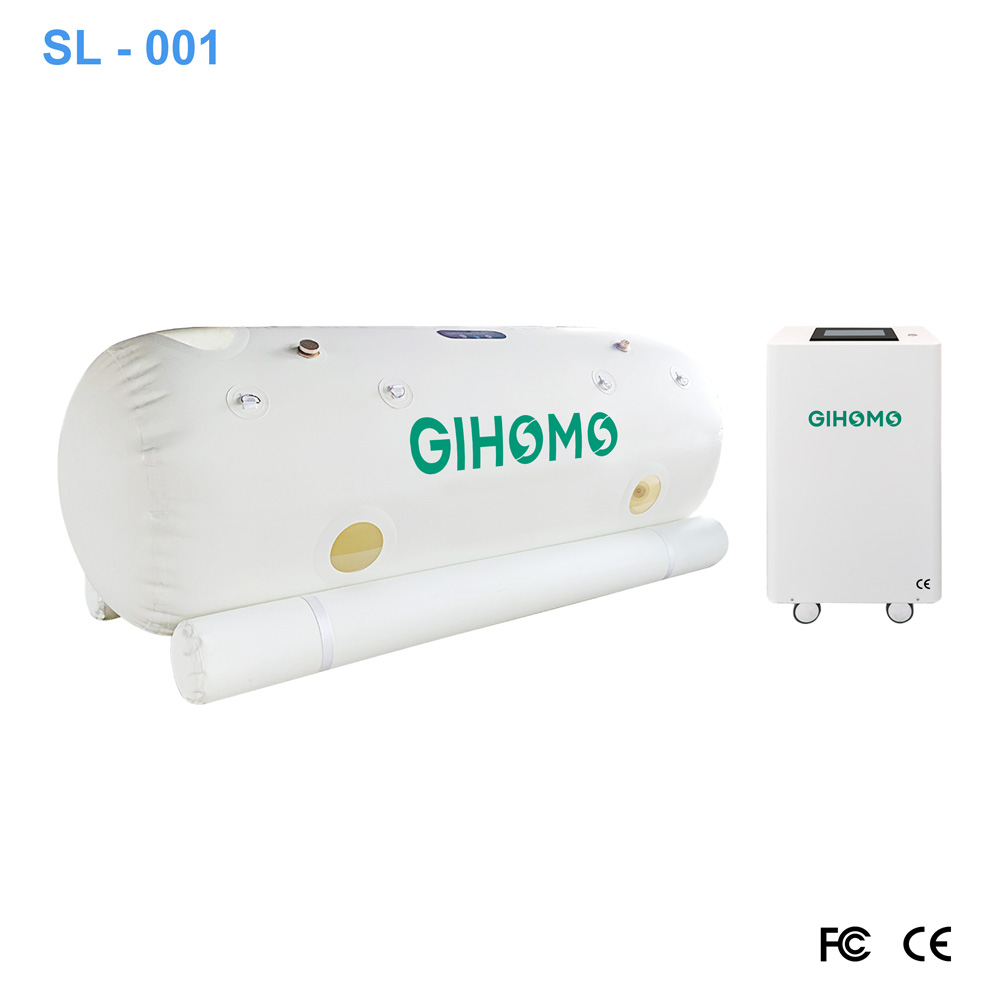
SL001: a lying type soft shell hyperbaric oxygen chamber in TPU, 1.3 ATA, interior and exterior display panels, 20.5 kg chamber weight.
Gate 2 — Pressure basis and oxygen chain sizing
This is the gate that separates a serious supplier from a catalogue. Two questions resolve most of it.
First, define the pressure. Ask whether the ATA figure is a maximum or a working pressure, and whether it is absolute or gauge. GIHOMO's listings range from 1.3 ATA (SL001, SC001, ST001, P4200, Y3000) through 1.5 ATA (STW01, STW03, SSL001, Y0780, Z0780H at 1.3–1.5 ATA) to 1.8 ATA (S920) and 2.0 ATA (W900, W1800, C750, C900, SH001). Where a soft shell listing sits at the top of the mild-pressure band, or a portable TPU listing at 2.0 ATA, the honest resolution is a definition question rather than an assumption: request the pressure-hold test report and the stated test conditions for that model.
Second, size the oxygen chain. The concentrator model, its flow rating, its delivery pressure and the stated purity form one system, and the system must match the occupancy and cycle time. In GIHOMO's catalogue the pairing is explicit: GH05A at 5 L/min and 100 kPa on SL001, SSL001 and ST001; GH15A at 15 L/min and 100 kPa on STW01 and STW03; GH15S-12A at 15 L/min and 120 kPa on Y1800, R1200 and C900; GH30S-12A at 30 L/min and 120 kPa on Y3000; GH30S-15A at 30 L/min and 140 kPa on S920; GH40S at 40 L/min and 100 kPa on P3600 and P4200; GH60S at 60 L/min on W1800 and P5480M; GY20SR at 20 L/min and 120 kPa on STW02 and P3300M; GY10S-10A at 10 L/min and 100 kPa on Z0880. Listed oxygen purity is above 90% across the range, and rated power runs from approximately 750 W on a GH05A-equipped soft shell chamber to approximately 5,000 W on the 60 L/min systems.
A 5 L/min concentrator paired with a multi-occupancy chamber is a specification mismatch, not a bargain. Ask the supplier to justify the concentrator selection against your intended session length and occupancy, and to provide the alarm thresholds and relief-valve configuration in writing.
Gate 3 — Certificate scope, not certificate presence
"CE certified" is a sentence, not evidence. A usable certification answer contains five fields: certificate number, issuing body, standard, covered model list, and validity. GIHOMO's published records can be read as a worked example of that structure.
| Certificate | Number | Issuing body | Standard | Listed markets |
|---|---|---|---|---|
| CE | JAT25062702642SC-1 | Dongguan Jun'an Testing & Certification Co., Ltd. | EN 60335-1:2012+A11:2014+A13:2017+A1:2019+A14:2019+A2:2019+A15:2021+A16:2023; EN 62233:2008 | EU, America, Canada, Australia, Mexico |
| CE (EMC) | JAT25062402743EC-1 | Dongguan Jun'an Testing & Certification Co., Ltd. | EN IEC 55014-1:2021; EN IEC 55014-2:2021 | EU, America, Canada, Australia, Mexico |
| EMC | UNIA23081019ER-11 | Shenzhen United Testing Technology Co., Ltd. | EN IEC 55014-1:2021; EN IEC 61000-3-2:2019+A1:2021; EN 61000-3-3:2013+A2:2021+AC:2022-01; EN IEC 55014-2:2021 | EU, America, Canada, Australia, Mexico |
| ISO 9001 | 21425Q0195R0S | Shenzhen Guo Heng Certification Co., Ltd. | GB/T 19001-2016 / ISO 9001:2015 | EU, America, Canada, Australia, Mexico |
| ISO 14001 | 21425E0089ROS | Shenzhen Guo Heng Certification Co., Ltd. | GB/T 24001-2016 / ISO 14001:2015 | EU, America, Canada, Australia, Mexico |
| ISO 45001 | 21425S0068ROS | Shenzhen Guo leng Certification Co., Ltd. | GB/T 45001-2020 / ISO 45001:2018 | EU, America, Canada, Australia, Mexico |
Certificate data as published by GIHOMO. Verify each number, scope and expiry directly with the issuing body before relying on it for market access.
Two clarifications matter when you read a table like this. Electrical safety and EMC certificates answer a product-safety question; they do not answer a medical-device authorization question. In the United States, a full-body hyperbaric chamber is a Class II device under 21 CFR 868.5470, and medical claims require 510(k) clearance — a separate document set. GIHOMO states that all core products hold CE and FCC certification; FCC and EMC are not medical-device authorizations either. If your business model depends on clinical claims, ask the regulatory question explicitly and in writing.

ISO 9001 certificate 21425Q0195R0S, issued by Shenzhen Guo Heng Certification Co., Ltd. against GB/T 19001-2016 / ISO 9001:2015.
Gate 4 — Capacity, lead time and order flexibility
Delivery assurance starts with numbers the supplier is willing to put in a quotation. GIHOMO quotes a monthly capacity of 80 units, a lead time of 30 to 45 days and a minimum order quantity of 1 unit, with quality control described as 100% test. Its stated export markets are the EU, North America, South America and Australia, and after-sales support is described as 24/7 instant response, one-to-one technical support from dedicated after-sales engineers, and a one-year warranty.
Convert each of those into a screening question. "Monthly capacity 80 units" becomes: what is uncommitted in the month my order lands, and can I see a production schedule? "Lead time 30–45 days" becomes: does the clock start at purchase order, at deposit, or at artwork approval for an OEM build? "100% test" becomes: what is tested, at what pressure, and is the record shipped with the unit?
Gate 5 — Acceptance criteria and purchasing terms
The final gate is the one most often skipped: decide what "accepted" means before the container leaves. Acceptance criteria should be written for the specific configuration — a soft shell chamber and a 60 L/min eight-seat room do not share a test script.

S920: an aluminium hyperbaric chamber with a BIBS system, 1.8 ATA, GH30S-15A concentrator at 30 L/min and 140 kPa.
Step-by-Step Breakdown: From Requirement to Signed Acceptance
- Freeze the requirement. Write down occupancy per session, sessions per day, intended use segment (wellness, sports recovery, rehabilitation support, home), available room dimensions, ceiling height, door width, floor loading and available power. Everything downstream is checked against this document.
- Normalise the specification sheet. For each candidate model, record: form factor (sitting, lying, portable), chamber material, pressure rating and its basis, oxygen concentrator model, flow at stated delivery pressure, oxygen purity, rated power, chamber dimensions and chamber weight.
- Match configuration to space and throughput. Confirm that the model physically fits and that the seat count matches your session model. Verify the concentrator selection against occupancy — 5 L/min, 15 L/min, 30 L/min, 40 L/min and 60 L/min systems serve very different rooms.
- Request the certificate pack. Ask for the certificate number, issuing body, standard, covered model list and expiry for each document, and confirm that the certificate references the exact model you are buying.
- Request capacity and scheduling evidence. Ask for the committed order book window, the production schedule for your target month, and the identity of the production site. GIHOMO's Verified Supplier profile lists two production lines, which is a starting point for an on-site or third-party audit rather than a conclusion.
- Fix the commercial terms. Confirm MOQ, Incoterm, packaging standard, lead-time start point, partial shipment policy, spare-parts list and warranty start date.
- Write the acceptance criteria. Agree the inspection and functional test script before shipment, and require serial-level records with the goods.
- Plan installation, training and service. Confirm who commissions the unit, who trains operators, the response time commitment, and the spare-parts route for the first year.
Pre-Order Purchasing Terms Checklist
Use this list as the minimum content of a purchase order for a hyperbaric oxygen chamber. It is written to be configuration-agnostic so it works for a single soft shell unit and for a multiplace room.
- Configuration block: model, form factor (sitting / lying / portable), capacity, chamber material, chamber dimensions, chamber weight.
- Performance block: pressure rating with basis stated (maximum vs working; absolute vs gauge), oxygen concentrator model, flow at stated delivery pressure, oxygen purity, rated power, voltage and plug standard.
- Interior block: sofa or chair type and quantity, oxygen outlet count, lighting, carpet and soft decoration, call bell or intercom, TV size, water-cooled air conditioner, massage chair if specified.
- Compliance block: certificate numbers and covered models, declaration of conformity, instructions for use, electrical safety test report, pressure-hold test report, relief-valve and alarm specification.
- Commercial block: MOQ, unit price, Incoterm, packaging, lead-time start point, delivery window, partial shipment terms, payment schedule, warranty period and start date.
- Acceptance block: incoming inspection items, functional test at operating pressure, leak-down check, alarm and relief-valve verification, accessory completeness, documentation pack, and the remedy if an item fails.
- After-sales block: response time, escalation path, engineer support model, spare-parts list and pricing basis, training scope.
Use Cases: Where Configuration and Verification Priorities Shift
Different buyer types weight the five gates differently. GIHOMO's case records show the spread of applications it serves, and each one implies a different acceptance emphasis.
- Home wellness: a one-person hard shell or soft shell unit where footprint, noise, power draw and single-occupancy comfort dominate. GIHOMO records a home-use deployment of 80 units over two years with stable operation. Acceptance emphasis: footprint, electrical safety documentation, and operator instruction quality.
- Gym and sports recovery: throughput and session turnaround dominate, which pushes toward sitting or lying configurations with quick access. GIHOMO records a gym deployment of 50 units over two years with stable operation. Acceptance emphasis: cycle time, concentrator capacity, upholstery durability.
- Beauty salon and spa: client experience and interior finish dominate. GIHOMO records a salon and spa deployment of 30 units over two years. Acceptance emphasis: interior fit-out specification, lighting, air conditioning, and surface finish quality on delivery.
- Wellness centre, clinic and nursing home: a mixed requirement covering one-person and multi-person rooms. GIHOMO records an 80-unit deployment across wellness centres, clinics, nursing homes and dental clinics over two years with positive reviews. Acceptance emphasis: certification scope, installation planning, staff training.
- ODM resellers: brand consistency and repeatability dominate. GIHOMO records a 100-unit ODM reseller programme over two years, with OEM/ODM customisation stated for logo, interface, colour and languages. Acceptance emphasis: change control, artwork approval, build-to-build consistency, packaging.
- Clinical and BIBS configurations: oxygen delivery method and documentation dominate. Models such as S920 (1.8 ATA, aluminium), P1800M, R1800M, P1200M and STW02 use BIBS systems. Acceptance emphasis: oxygen-delivery configuration, alarm verification, instruction-for-use completeness.
Comparison Table: GIHOMO Model Configuration Matrix
The matrix below normalises ten configurations from the GIHOMO catalogue using the same fields, which is the format to demand from any supplier you shortlist. It is a specification comparison, not a ranking, and it does not replace model-specific test reports.
| Model | Form / capacity | Material | Pressure | Concentrator & flow | O₂ pressure / purity | Rated power | Chamber size |
|---|---|---|---|---|---|---|---|
| SL001 | Soft shell, lying | TPU | 1.3 ATA | GH05A, 5 L/min | 100 kPa / >90% | ≈750 W | D2200mm × 800mm (20.5 kg) |
| SSL001 | Soft shell, 1.5 ATA | TPU | 1.5 ATA | GH05A, 5 L/min | 100 kPa / >90% | ≈750 W | 1700 × 1100 × 1200 mm (24.5 kg) |
| STW01 | Soft shell, sitting | TPU | 1.5 ATA | GH15A, 15 L/min | 100 kPa / >90% | ≈850 W | 1820 × 820 × 1500 mm |
| SH001 | Portable, lying | TPU | 2.0 ATA | GH15S-12A, 15 L/min | 120 kPa / >90% | ≈1100 W | D800mm × 2000mm |
| Z0780H | Hard shell, one person | Steel | 1.3–1.5 ATA | GH15A-12A, 15 L/min | 120 kPa / >90% | ≈850 W | 1350 × 780 × 1880 mm |
| Y1800 | Hard shell, two persons | Steel | 1.3–1.5 ATA | GH15S-12A, 15 L/min | 120 kPa / >90% | ≈1100 W | 2200 × 1800 × 1900 mm |
| Y3000 | Hard shell, four persons | Steel | 1.3 ATA | GH30S-12A, 30 L/min | 120 kPa / >90% | ≈2500 W | 2200 × 3000 × 1900 mm |
| S920 | Hard shell with BIBS | Aluminium | 1.8 ATA | GH30S-15A, 30 L/min | 140 kPa / >90% | ≈2500 W | 2012 × 920 × 1580 mm |
| W900 | 2.0 ATA sitting type | Steel | 2.0 ATA | GH15S-12A, 15 L/min | 120 kPa / >90% | ≈1100 W | 900 × 1500 × 1900 mm |
| C900 | 2.0 ATA lying type | Aluminium | 2.0 ATA | GH15S-12A, 15 L/min | 120 kPa / >90% | ≈1100 W | Φ900mm × 2100mm |
Specifications as listed by GIHOMO. Confirm the pressure basis, test conditions and oxygen purity measurement method for the exact model before ordering.
Frequently Asked Questions
Which certificates should a hyperbaric oxygen chamber supplier provide, and how do I verify them?
Ask for the certificate number, issuing body, standard, covered model list and validity date, then check each field against the document. GIHOMO's soft shell hyperbaric chamber records cite CE certificate JAT25062702642SC-1 issued by Dongguan Jun'an Testing & Certification Co., Ltd. against EN 60335-1:2012+A11:2014+A13:2017+A1:2019+A14:2019+A2:2019+A15:2021+A16:2023 and EN 62233:2008, plus CE EMC certificate JAT25062402743EC-1 against EN IEC 55014-1:2021 and EN IEC 55014-2:2021. The EMC certificate UNIA23081019ER-11 was issued by Shenzhen United Testing Technology Co., Ltd. against EN IEC 55014-1:2021, EN IEC 61000-3-2:2019+A1:2021, EN 61000-3-3:2013+A2:2021+AC:2022-01 and EN IEC 55014-2:2021. Management-system certificates are ISO 9001 21425Q0195R0S, ISO 14001 21425E0089ROS and ISO 45001 21425S0068ROS, listed for the EU, America, Canada, Australia and Mexico markets. Electrical safety and EMC certificates are not medical device market authorization: a full-body hyperbaric chamber is a Class II device under 21 CFR 868.5470 in the United States, and FDA 510(k) clearance is a separate question you must ask explicitly.
How do I verify the claimed pressure, oxygen flow and concentration specifications?
Normalise every number before comparing. Confirm whether the stated ATA is a maximum or a working pressure, and whether it is absolute or gauge, then match the oxygen concentrator to the number of occupants. GIHOMO pairs the GH05A concentrator at 5 L/min and 100 kPa with the SL001, SSL001 and ST001 soft shell chambers; the GH15A at 15 L/min and 100 kPa with the STW01 and STW03; the GH15S-12A at 15 L/min and 120 kPa with the Y1800, R1200 and C900; the GH30S-12A at 30 L/min and 120 kPa with the Y3000; the GH30S-15A at 30 L/min and 140 kPa with the S920; the GH40S at 40 L/min and 100 kPa with the P3600 and P4200; and the GH60S at 60 L/min with the W1800 and P5480M. Listed oxygen purity is above 90% across the range. Ask for a pressure-hold test report, relief-valve and alarm verification, and the electrical safety report for the exact model rather than the product family.
What actually drives the price difference between two chambers that look identical?
Five cost drivers explain most of the gap: chamber material (TPU, steel, aluminium or carbon fibre), pressure rating, oxygen concentrator flow and rated power, interior fit-out, and certification scope. For scale, GIHOMO listings run from approximately 750 W on a GH05A-equipped soft shell chamber to approximately 5,000 W on a 60 L/min hard shell system, and interior configurations range from a fixed sofa with a single oxygen outlet to eight chairs with eight oxygen outlets, wireless intercom and a water-cooled air conditioner. Ask for a line-item quotation that maps each cost to a specification, and treat a quotation that cannot be broken down that way as incomplete. Use the material and dimension fields as well: a carbon fibre hard shell chamber with a 2100mm × 1100mm × 1350mm inner size and a TPU chamber weighing 20.5 kg are not comparable line items even when their ATA figures match.
Can we validate a chamber with a sample before committing to a bulk order?
Yes. GIHOMO's stated minimum order quantity is 1 unit, so a single production-configuration chamber can be ordered, tested and then used as the reference build for a larger order. Lead time is quoted at 30 to 45 days and quality control is described as 100% test. Agree the acceptance checklist in writing before the sample ships, record the serial-level test results, and photograph the packaging on arrival — the value of a sample is the reference it creates, not the unit itself.
What delivery and acceptance terms should be fixed before the order is placed?
Fix five things: the lead-time start point (purchase order, deposit or artwork approval), the stated monthly capacity, the Incoterm and packaging standard, the documentation pack, and the acceptance criteria. GIHOMO quotes a monthly capacity of 80 units and a lead time of 30 to 45 days, supported by 24/7 response, one-to-one technical support from after-sales engineers and a one-year warranty. If you want those terms tested against a real configuration, send your requirement to GIHOMO at www.gihomo.com or gihomo@hotmail.com and request a written quotation together with a sample plan and acceptance checklist.
Conclusion
Supplier evaluation for a hyperbaric oxygen chamber is a document exercise before it is a price exercise. Configuration fit decides whether the unit can be installed; the pressure and oxygen-chain basis decides whether it can perform the session you designed; certificate scope decides which markets and claims are open to you; capacity and lead-time evidence decides whether it arrives when promised; and written acceptance criteria decide whether the handover is a formality or a dispute.
Worked examples from GIHOMO's catalogue — a 1.5 ATA sitting soft shell chamber on a GH15A concentrator, a two-person hard shell room on a GH15S-12A, an aluminium BIBS chamber at 1.8 ATA on a GH30S-15A, and a 60 L/min eight-seat room — show how specific a verifiable answer looks. Hold every supplier you shortlist to that same level of specificity, and the comparison becomes an evaluation rather than a negotiation.
Next Step: Test the Five Gates on Your Own Specification
Send your occupancy, room dimensions, target pressure and destination market to GIHOMO and ask for a configuration proposal, a certificate pack matched to the specific model, and a written acceptance checklist. Contact: Morgan, WhatsApp +852 68176191, Tel +86 13118899348, email gihomo@hotmail.com, or visit www.gihomo.com.
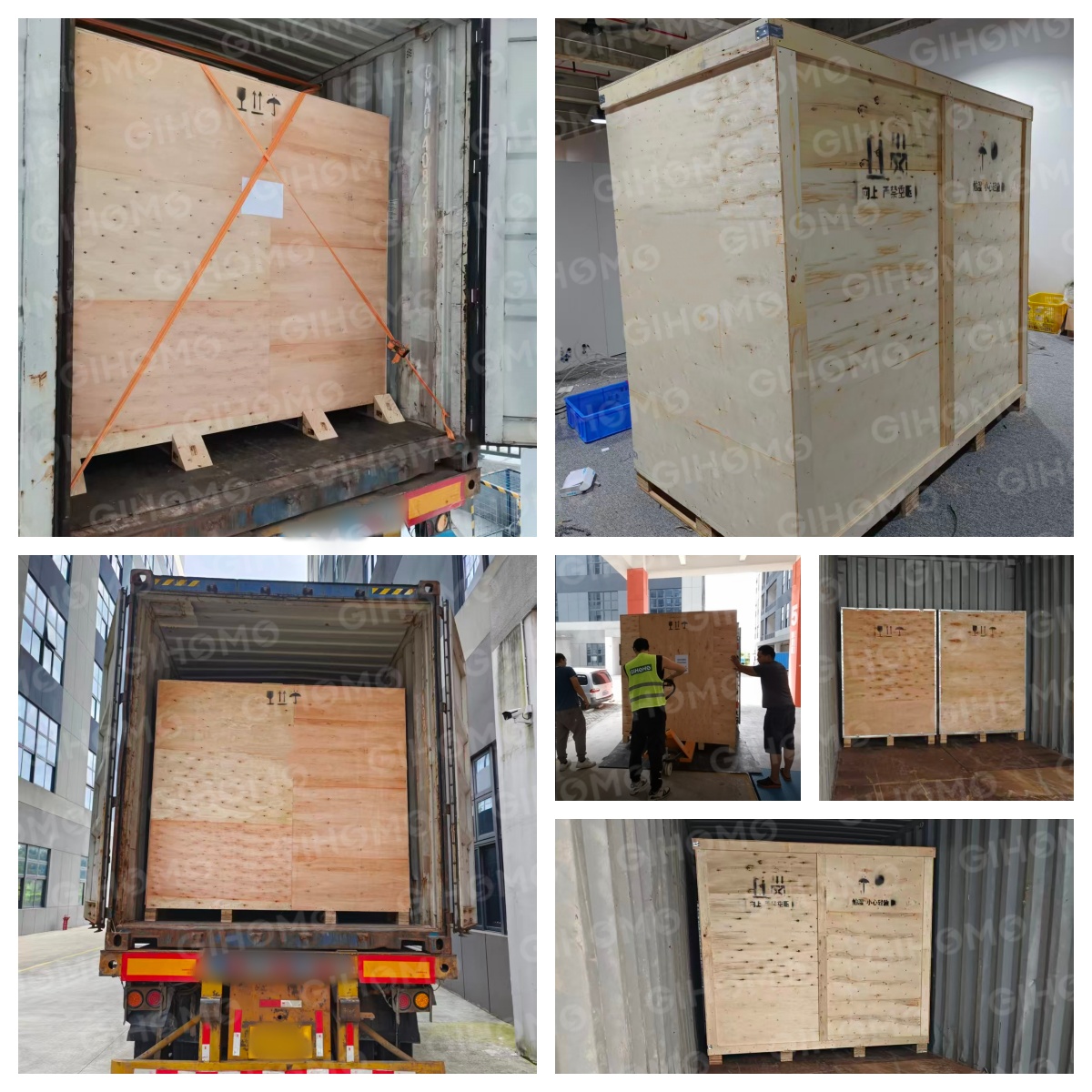
Delivery assurance: inspect packaging, documentation and serial-level test records before dispatch, not after arrival.
Have Questions or Need More Details?
Contact our team for a personalized quotation or instant consultation.
Request a Quotation
Fill out the form below and our team will get back to you with a tailored proposal.
WhatsApp Direct Chat
Prefer to chat in real-time? Message us on WhatsApp for instant assistance & quick answers.
- Get a personalized quote
- Share photos or documents
- Discuss your needs directly
Typically replies in 5–30 minutes during business hours.