
Soft Shell vs. Portable vs. Lying-Type Chambers: A Buyer's Comparison Guide
Soft Shell vs. Portable vs. Lying-Type Chambers: A Buyer's Comparison Guide
Short answer: the three labels answer three different questions. Soft shell describes the enclosure material — a TPU shell instead of steel or aluminum. Portable describes how a unit is moved, stored and re-deployed. Lying-type describes the position of the person inside the chamber. A single unit can be all three at once, which is exactly what a 1.5ATA TPU lying-type chamber is. The useful comparison is therefore not which label wins, but which combination of pressure, oxygen flow, oxygen purity, footprint and power fits your site.
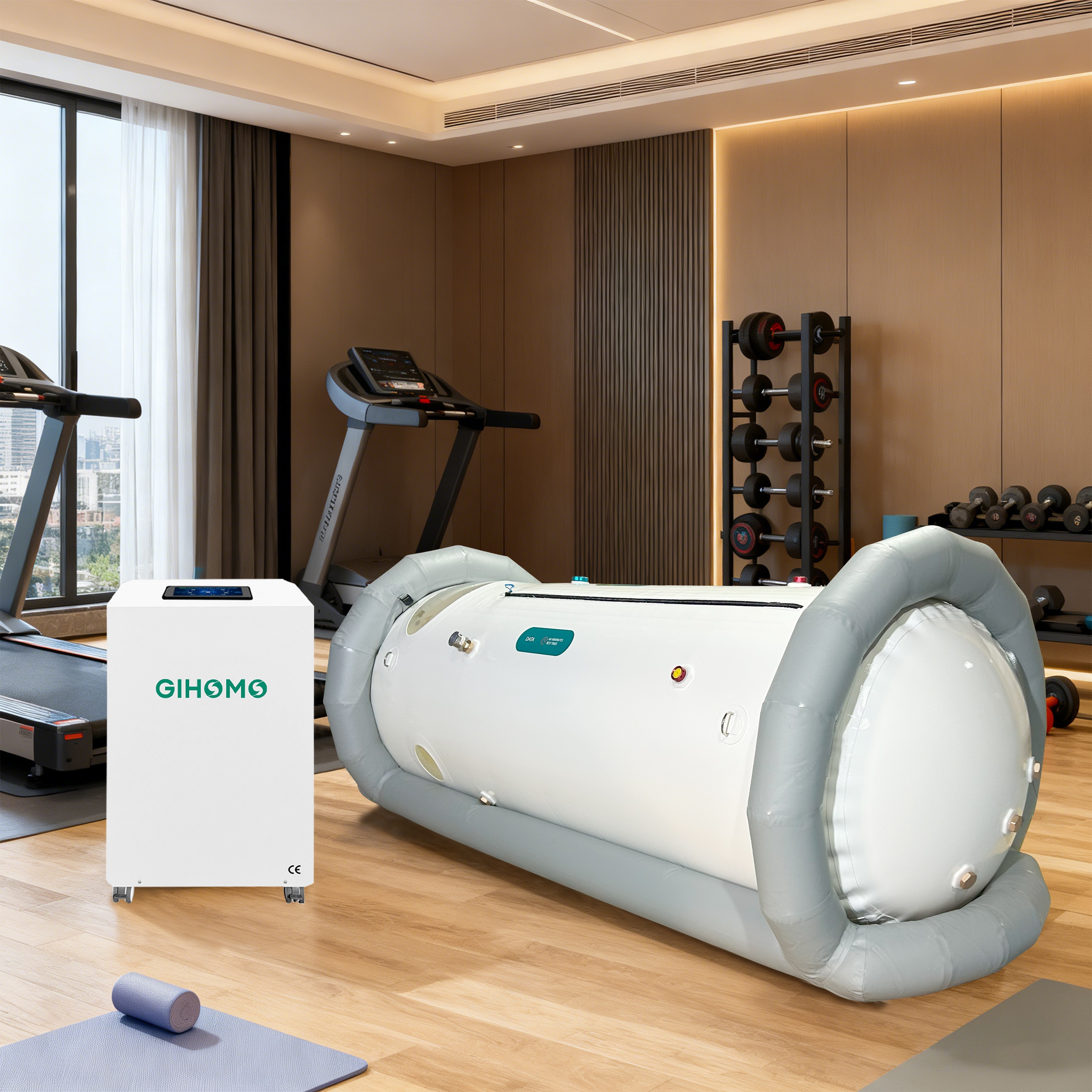
Buyers who search for soft shell versus portable hyperbaric chambers usually end up comparing a material category against a deployment category. The request for quotation that follows then mixes specifications that do not belong together: a pressure target with no oxygen flow figure, a chamber footprint with no rated power, or a delivery method with no concentrator model. The result is a set of proposals that cannot be compared like for like, and a purchase decision that rests on photographs rather than on data.
This guide separates the three formats first, then compares them on the variables that actually decide whether a unit suits a home, a wellness studio, a sports facility or a rehabilitation room: operating pressure, oxygen delivery, oxygen purity, chamber dimensions, rated power and delivery method. All model-level figures below come from the published specifications of one manufacturer range, Guangdong GIHOMO Medical Technology Co., Ltd., which builds both hard shell and portable hyperbaric oxygen chambers and exports a majority of its output.
The Problem: Three Labels, Three Different Dimensions
Almost all confusion in this product category comes from treating three independent variables as if they were one. The first variable is material. Soft shell chambers are built from TPU; hard shell chambers are built from steel or aluminum. The second variable is deployment. Portable describes relocation and folding, not capability. The third variable is posture. Sitting-type and lying-type describe how the patient enters and remains inside the chamber, and both postures exist in soft shell as well as in hard shell construction.
Once those axes are separated, four assumptions that regularly distort soft shell, portable and lying-type comparisons become visible.
- Assuming soft shell means 1.5ATA. Within the GIHOMO soft shell range, the ST001, SC001 and SL001 models operate at 1.3ATA, while the SSL001, STW01 and STW03 models operate at 1.5ATA. Pressure has to be written into the specification independently of the material.
- Assuming portable means less capable. The SH001 is a portable, TPU-clad, lying-type chamber and it operates at 2.0ATA, with a GH15S-12A oxygen concentrator delivering 15L/min at 120KPa and a rated power of approximately 1,100W.
- Assuming oxygen flow is consistent across formats. Concentration flow moves from 5L/min on GH05A-equipped models (SSL001, SL001, ST001) through 10L/min on SC001 and 15L/min on STW01, STW03, SS002, SH001, C750 and C900, up to 20L/min on the BIBS-equipped portable STW02.
- Treating power as a detail. Rated power for these configurations runs from approximately 750W to approximately 1,500W, and it follows the concentrator model rather than the chamber format. Electrical planning done for a 750W unit does not automatically serve a 1,500W unit.
A specification that names only the format is therefore incomplete. Written correctly, a brief would read: lying-type, TPU soft shell, 1.5ATA operating pressure, GH15A oxygen concentrator, 15L/min concentration flow, oxygen purity above 90%, chamber size D1000mm x 2350mm, rated power approximately 850W. That is the published configuration of the STW03.
Industry Background: Why Format Choice Is Now a Specification Exercise
The commercial context explains why this level of detail has become normal. Grand View Research estimates the global hyperbaric oxygen therapy (HBOT) market at USD 3.71 billion in 2024, projected to reach USD 5.19 billion by 2030, while Strategic Market Research and SkyQuest place 2024 at USD 4.44 billion with a projected CAGR of 9.4% through 2032. The two figures differ mainly in whether wellness applications are counted alongside clinical ones, so they are best read as direction rather than as a single-point market size.
Within that market, Mordor Intelligence reports that monoplace chambers accounted for approximately 57% of global revenue share in 2024, driven largely by ease of operation, and that North America held a 54.77% revenue share in the same year. Grand View Research identifies Asia Pacific as the fastest-growing region, with China projected to reach USD 379.7 million by 2030, and soft-shell portable chambers are reported as exceeding 18% of total sales in Asia Pacific, supported by wellness and athletic recovery demand.
Regulation is the second reason the specification matters more than the label. The U.S. FDA classifies hyperbaric chambers as Class II medical devices requiring 510(k) clearance, and soft-shell chambers in particular are primarily cleared for altitude sickness. In the European Union, all hyperbaric chambers — mild or clinical — must comply with Medical Device Regulation (MDR) 2017/745 as Class IIb devices, while multiplace chambers must additionally meet EN 14931 and the fire safety requirements set out in EN 16081.
The practical consequence is straightforward. Most of the growth sits in the monoplace soft-shell segment, which is precisely the segment where the soft shell, portable and lying-type labels overlap. Format alone no longer separates one offer from another; the specification and the compliance route do.
Format by Format: What the GIHOMO Range Contains
GUANGDONG GIHOMO MEDICAL TECHNOLOGY CO., LTD. is a medical equipment manufacturer established in 2021 and based in Foshan, Guangdong, operating a 2,000 m² facility with a workforce of approximately 50–100 staff, a six-engineer R&D team and an annual production capacity of roughly 1,000 units. Its main products are hard shell hyperbaric oxygen chambers and portable hyperbaric oxygen chambers, with exports accounting for approximately 60% of sales and the EU and the USA as its main markets. The models below are grouped by the label each one answers first.
Soft shell chambers — the material-first category
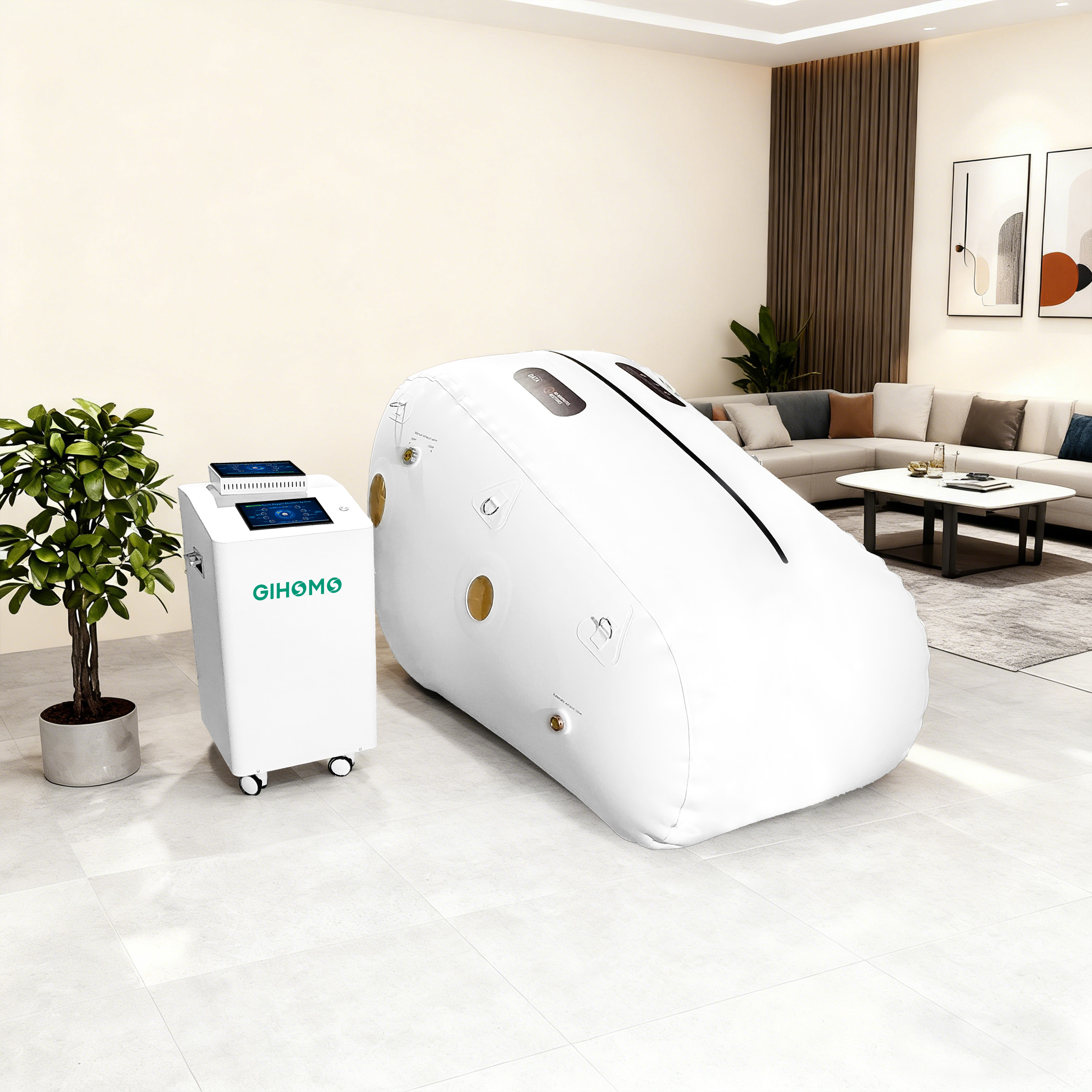
Soft shell describes the TPU enclosure. Inside this category, the range splits by posture rather than by pressure, and both 1.3ATA and 1.5ATA ratings appear.
- SSL001 — a 1.5ATA soft shell hyperbaric oxygen chamber built from TPU, with a GH05A oxygen concentrator delivering 5L/min at 100KPa and oxygen purity above 90%, rated power approximately 750W, chamber size 1700mm x 1100mm x 1200mm, and a chamber net weight of 24.5kg.
- STW01 — a sitting-type soft shell chamber at 1.5ATA, with a GH15A concentrator delivering 15L/min at 100KPa, purity above 90%, rated power approximately 850W and chamber size 1820mm x 820mm x 1500mm.
- ST001 — a sitting-type soft shell chamber at 1.3ATA, with the GH05A concentrator at 5L/min, purity above 90%, rated power approximately 750W and chamber size 1700mm x 1500mm x 1000mm.
- SC001 — a sitting-type soft shell chamber at 1.3ATA, with a GH10S-10A concentrator at 10L/min and 100KPa, purity above 90%, rated power approximately 850W and chamber size 1400mm x 1600mm x 1000mm.
Two observations matter for specification work. First, the 1.5ATA rating appears with two very different oxygen supplies — the 5L/min GH05A on SSL001 and the 15L/min GH15A on STW01 — which confirms that pressure and flow are selected independently. Second, the GH05A is the integrated concentrator used across the lower-flow models in this range, so a buyer who needs a 1.5ATA soft shell chamber should still confirm which concentrator is fitted before treating two quotes as equivalent.
Portable chambers — the deployment-first category
Portability is a property of deployment: the unit can be folded, relocated and re-commissioned at another site. In this range, the portable models are also the ones that carry the larger oxygen systems and the multi-occupant configurations.
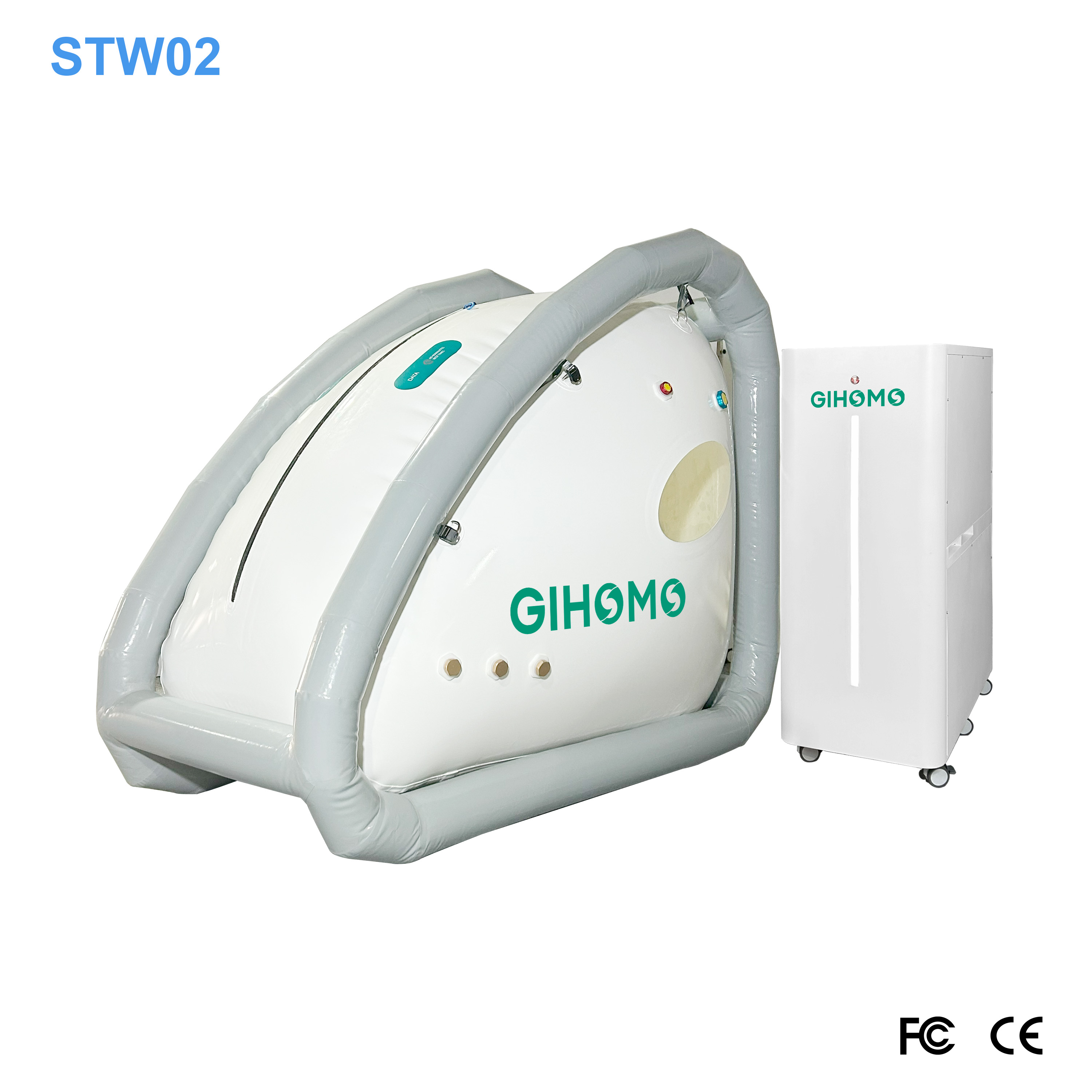
- STW02 — a portable hyperbaric chamber with a Built-In Breathing System (BIBS) at 1.5ATA, equipped with a GY20SR concentrator delivering 20L/min at 120KPa, purity above 90%, rated power approximately 1,500W and chamber size 1900mm x 920mm x 1500mm.
- SS002 — a two-person portable chamber at 1.3ATA, with a GH15S-10A concentrator at 15L/min and 120KPa, purity above 90%, rated power approximately 1,100W and chamber size 1600mm x 1200mm x 1300mm.
- SH001 — a lying-type portable chamber built from TPU at 2.0ATA, intended for sport recovery, with a GH15S-12A concentrator at 15L/min and 120KPa, purity above 90%, rated power approximately 1,100W and chamber size D800mm x 2000mm.
The BIBS configuration on STW02 is the clearest example of why the delivery method must be specified. BIBS moves oxygen delivery from the chamber atmosphere to a dedicated breathing circuit, and that change is what justifies the 20L/min GY20SR concentrator in place of the 15L/min unit used on the 1.5ATA lying-type soft shell model.
Lying-type chambers — the posture-first category
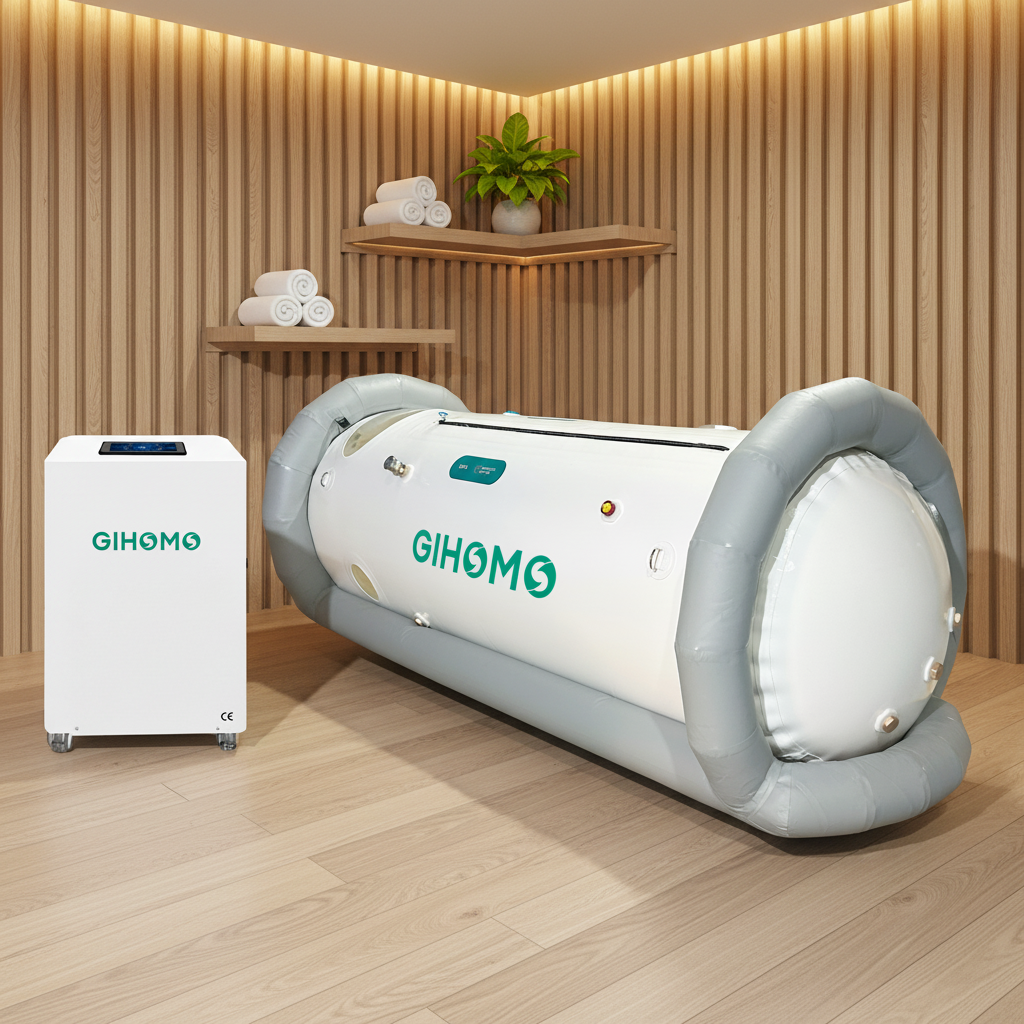
Lying-type describes the patient position: horizontal entry, with oxygen supplied through the chamber atmosphere, a BIBS circuit or an oxygen mask. This is the category where the labels overlap most, because lying-type exists in soft shell TPU and in hard shell aluminum.
- SL001 — a lying-type soft shell hyperbaric oxygen chamber at 1.3ATA, built from TPU, with a GH05A concentrator at 5L/min and 100KPa, purity above 90%, rated power approximately 750W, chamber size D2200mm x 800mm, net weight 20.5kg and interior and exterior display panels for control.
- STW03 — a lying-type soft shell chamber at 1.5ATA, with a GH15A concentrator at 15L/min and 100KPa, purity above 90%, rated power approximately 850W and chamber size D1000mm x 2350mm.
- C900 — for comparison within the same posture, a hard shell lying-type chamber in aluminum at 2.0ATA, with a GH15S-12A concentrator at 15L/min and 120KPa, purity above 90%, rated power approximately 1,100W and dimensions of Φ900mm x 2100mm.
- C750 — a hard shell lying-type chamber in aluminum at 2.0ATA, with 15L/min flow, 120KPa concentration pressure, purity above 90%, rated power approximately 1,100W, an oxygen mask as the inhalation method and dimensions of Φ750mm x 2100mm.
Set side by side, the lying-type group shows the real trade-off: identical patient posture, two materials, two pressure bands and different site requirements. A buyer who specifies only lying-type has specified almost nothing.
Shared site and configuration requirements
Once the format is fixed, the same site-level requirements appear across the application scenarios GIHOMO publishes. The working condition is an indoor, cool and ventilated environment, and the operating mode is 24/7. The matched equipment set typically includes a water-cooled air conditioner, a 24V power supply, the oxygen concentrator, two manual pressure relief valves and automatic pressure relief valves. Certification options cover CE, FCC and EMC, and ODM/OEM service is available where branding or configuration changes are required.
A Five-Step Comparison Process for Buyers
The sequence below converts the three labels into a defensible purchase specification. It works for a single unit as well as for a multi-site rollout.
- Fix the pressure target before anything else. Decide between 1.3ATA, 1.5ATA and 2.0ATA and write the number into the brief. 1.5ATA is the most common soft shell rating in this range (SSL001, STW01, STW03), but it is not universal — ST001, SC001 and SL001 are rated at 1.3ATA, and SH001, C750 and C900 reach 2.0ATA.
- Choose posture and occupancy. Sitting type covers ST001, STW01 and SC001; lying type covers SL001, STW03, SH001, C750 and C900. Where two occupants must be treated in one cycle, the portable SS002 is the two-person configuration in this range.
- Size the oxygen supply to the delivery method. Chamber-atmosphere delivery, a BIBS circuit such as the one on STW02, and an oxygen mask as used on C750 are not interchangeable, because each changes how a flow figure translates into the actual session. Concentration flow options here are 5, 10, 15 and 20L/min, concentration pressure is 100KPa or 120KPa depending on the model, and oxygen purity is above 90% across the range.
- Check the site against footprint and power. Chamber sizes run from 1400mm x 1600mm x 1000mm on the SC001 to D1000mm x 2350mm on the STW03, and rated power runs from approximately 750W on GH05A-equipped units to approximately 1,500W on the GY20SR-equipped STW02. Ventilation, floor area and the electrical circuit should be confirmed against the specific model, not against the format.
- Confirm the compliance route and customization options. Match the intended market to the regulatory framework — FDA Class II with 510(k) clearance in the United States, MDR 2017/745 Class IIb in the European Union — then confirm which certifications and documentation the supplier provides, and whether ODM/OEM service is required for branding or configuration changes.
Category Comparison Table: Soft Shell vs. Portable vs. Lying-Type
The table below compares the three labels as categories, using only configurations published in the GIHOMO range. It shows why a buyer can hold a valid 1.5ATA soft shell quote, a valid portable quote and a valid lying-type quote at the same time — and still be comparing three different machines.
| Decision dimension | Soft shell | Portable | Lying-type |
|---|---|---|---|
| What the label describes | Enclosure material (TPU) | Deployment and relocation | Patient posture inside the chamber |
| Materials in this range | TPU | TPU | TPU (soft shell) or aluminum (hard shell) |
| Pressure range in this range | 1.3ATA – 1.5ATA | 1.3ATA – 2.0ATA | 1.3ATA – 2.0ATA |
| Oxygen delivery method | Chamber atmosphere | Chamber atmosphere; BIBS on STW02 | Chamber atmosphere; oxygen mask on C750 |
| Concentrator models used | GH05A, GH10S-10A, GH15A | GH15S-10A, GH15S-12A, GY20SR | GH05A, GH15A, GH15S-12A |
| Concentration flow | 5 – 15L/min | 15 – 20L/min | 5 – 15L/min |
| Oxygen purity | Above 90% | Above 90% | Above 90% |
| Rated power (approx.) | 750 – 850W | 1,100 – 1,500W | 750 – 1,100W |
| Occupancy in this range | 1 person | 1 – 2 persons | 1 person |
| Example models | SSL001, STW01, ST001, SC001 | STW02, SS002, SH001 | SL001, STW03, C900, C750 |
Model-Level Specification Comparison
Category tables narrow a search; model tables close a purchase. The following configurations are published for the GIHOMO range, with the oxygen concentrator listed because it — rather than the chamber label — sets the flow, the purity and much of the power requirement.
| Model | Format | Pressure | Concentrator | Flow | Purity | Rated power | Chamber size |
|---|---|---|---|---|---|---|---|
| SSL001 | Soft shell | 1.5ATA | GH05A | 5L/min | Above 90% | approx. 750W | 1700 x 1100 x 1200mm |
| STW01 | Sitting-type soft shell | 1.5ATA | GH15A | 15L/min | Above 90% | approx. 850W | 1820 x 820 x 1500mm |
| ST001 | Sitting-type soft shell | 1.3ATA | GH05A | 5L/min | Above 90% | approx. 750W | 1700 x 1500 x 1000mm |
| SC001 | Sitting-type soft shell | 1.3ATA | GH10S-10A | 10L/min | Above 90% | approx. 850W | 1400 x 1600 x 1000mm |
| SL001 | Lying-type soft shell | 1.3ATA | GH05A | 5L/min | Above 90% | approx. 750W | D2200 x 800mm (20.5kg) |
| STW03 | Lying-type soft shell | 1.5ATA | GH15A | 15L/min | Above 90% | approx. 850W | D1000 x 2350mm |
| STW02 | Portable with BIBS | 1.5ATA | GY20SR | 20L/min | Above 90% | approx. 1,500W | 1900 x 920 x 1500mm |
| SS002 | Portable, two-person | 1.3ATA | GH15S-10A | 15L/min | Above 90% | approx. 1,100W | 1600 x 1200 x 1300mm |
| SH001 | Lying-type portable | 2.0ATA | GH15S-12A | 15L/min | Above 90% | approx. 1,100W | D800 x 2000mm |
| C900 | Lying-type hard shell | 2.0ATA | GH15S-12A | 15L/min | Above 90% | approx. 1,100W | Φ900 x 2100mm |
| C750 | Lying-type hard shell | 2.0ATA | Not stated in published parameters | 15L/min | Above 90% | approx. 1,100W | Φ750 x 2100mm |
Use Cases: Matching Format to Application
GIHOMO publishes four application domains for these chambers — rehabilitation, sport recovery, health care, and beauty and anti-aging — and the format that fits each one follows from the same five variables rather than from the label.
- Wellness and beauty studios. Sitting-type soft shell chambers at 1.3ATA (ST001, SC001) or 1.5ATA (STW01) suit rooms where clients remain seated and sessions are scheduled through the day. The application function GIHOMO publishes for beauty and anti-aging is to promote collagen regeneration, brighten skin tone and accelerate skin repair. These are the manufacturer's stated application functions rather than independently verified clinical outcomes, and they should not be presented to end users as clinical claims.
- Home health care. Chamber weight becomes a decision variable here: SSL001 weighs 24.5kg net and SL001 weighs 20.5kg net, while both operate from a standard concentrator at 100KPa. The application function listed for health care is to improve sleep, enhance immunity and support daily health management.
- Sport recovery. The 1.5ATA soft shell models STW01 and STW03 are commonly matched to recovery rooms, and the portable SH001 at 2.0ATA extends the same use case to travel, camps and event venues. GIHOMO lists the function of this application as rapid recovery after exercise, improved training efficiency and enhanced athletic performance.
- Rehabilitation settings. Lying-type configuration supports longer, supine sessions, which places STW03 and the portable SH001 at the centre of this application. The function GIHOMO publishes for rehabilitation is adjuvant therapy for postoperative wound healing, diabetes, brain injury and other diseases.
- Facilities that require 2.0ATA with rigid geometry. Where a fixed room and a hard enclosure are preferred, the lying-type C750 and C900 provide 2.0ATA in aluminum at 15L/min and approximately 1,100W.
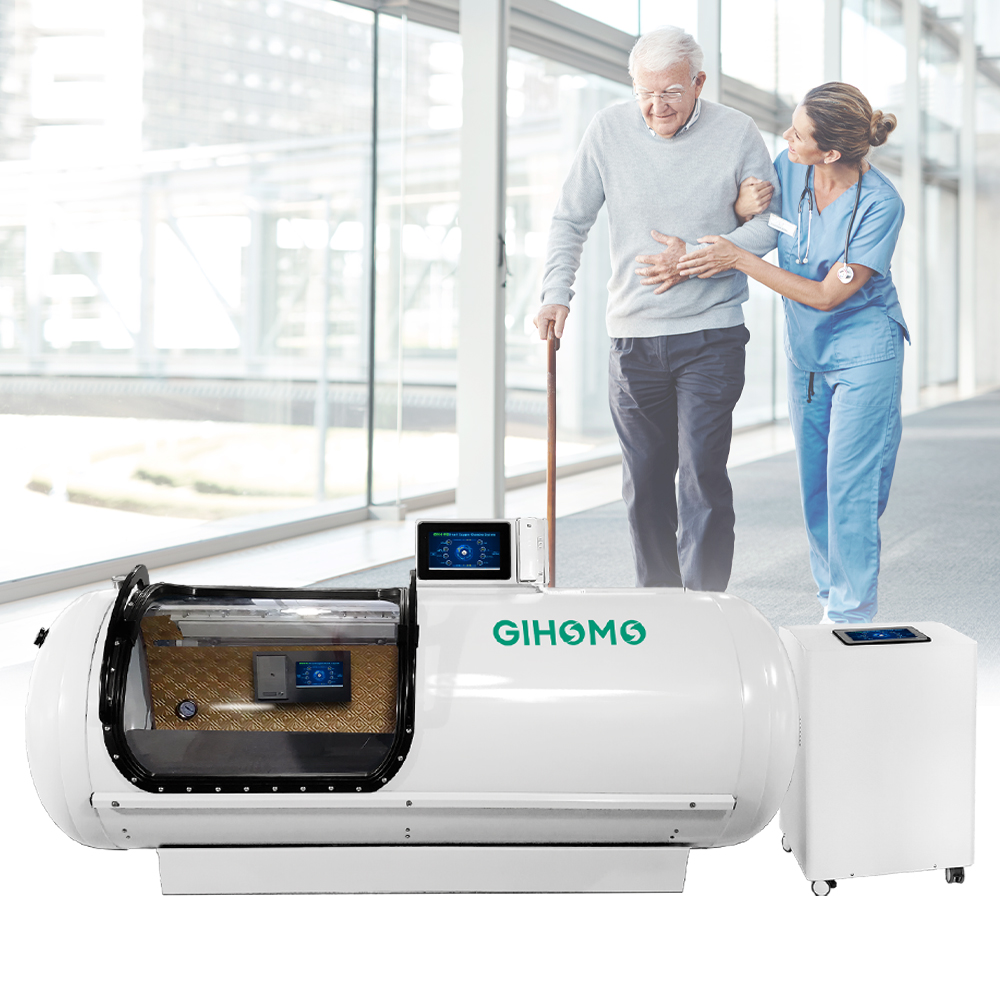
Frequently Asked Questions
Do soft shell and portable hyperbaric chambers need medical device certification?
Regulation follows the market, not the format. In the United States, the FDA classifies hyperbaric chambers as Class II medical devices requiring 510(k) clearance, and soft-shell chambers are primarily cleared for altitude sickness. In the European Union, every hyperbaric chamber — mild or clinical — must comply with Medical Device Regulation (MDR) 2017/745 as a Class IIb device, and multiplace chambers must additionally meet EN 14931 and the fire safety requirements in EN 16081. GIHOMO's core products carry CE and FCC certification, and the application requirements published for its range also list EMC certification alongside ODM/OEM service.
Can a soft shell chamber hold 1.5ATA and deliver 15L/min of oxygen?
Yes. Two GIHOMO models pair precisely that specification. STW03 is a lying-type soft shell chamber operating at 1.5ATA with a GH15A oxygen concentrator delivering 15L/min at 100KPa and oxygen purity above 90%, at a rated power of approximately 850W. STW01 is a sitting-type soft shell chamber with the same 1.5ATA, 15L/min, above 90% and approximately 850W combination. Buyers with a lower flow requirement can specify the GH05A concentrator used on SSL001, SL001 and ST001, but a 5L/min unit should not be expected to serve the same demand profile as a 15L/min or 20L/min configuration.
What drives the cost difference between soft shell, portable and lying-type chambers?
List prices are not published for these configurations, so comparison has to be built from the cost drivers visible in the specification. Those are the pressure rating (1.3ATA, 1.5ATA or 2.0ATA), the concentrator model and its flow (GH05A at 5L/min, GH10S-10A at 10L/min, GH15A and GH15S-12A at 15L/min, GY20SR at 20L/min), the rated power that follows from that choice (approximately 750W to approximately 1,500W), the chamber dimensions and material, the oxygen delivery method (chamber atmosphere, BIBS or oxygen mask), and the number of occupants. Two chambers that look identical in a product photograph can differ on four of those six variables.
How should a buyer validate a configuration before placing an order?
Validate data points rather than labels. Five figures should be confirmed against the model datasheet: operating pressure, oxygen concentrator model, concentration flow, oxygen purity, and chamber dimensions — plus rated power for the electrical plan. Confirm the delivery method as well, because chamber atmosphere, a BIBS circuit such as the one on STW02, and an oxygen mask such as the one on C750 translate the same flow figure into different session patterns. Where a site does not fit a standard footprint, GIHOMO provides ODM/OEM service, so the configuration can be adjusted before the order is finalised.
Is supply repeatable, and how should delivery be planned?
GIHOMO manufactures at a 2,000 m² facility with an annual production capacity of approximately 1,000 units and a workforce of 50–100 staff, with exports accounting for roughly 60% of sales and the EU and USA as its main markets. Those figures describe capacity rather than a delivery date: lead time depends on the configuration, the concentrator model chosen and the certification documentation required for the destination market, so it should be confirmed order by order rather than assumed from the format. To confirm a specification, request a quotation or discuss a project, contact GIHOMO at gihomo@hotmail.com, by telephone at +86 13118899348, or via WhatsApp at +852 68176191, or review the model range at www.gihomo.com.
Conclusion
Soft shell, portable and lying-type are useful search terms and poor purchase specifications. Soft shell tells you the enclosure is TPU; portable tells you the unit can be relocated; lying-type tells you the patient is supine. None of the three tells you whether the chamber holds 1.3ATA or 2.0ATA, whether the concentrator delivers 5L/min or 20L/min, whether purity stays above 90%, or whether the installation will draw 750W or 1,500W.
The comparison that actually decides a purchase runs in one direction: set the pressure target first, then posture and occupancy, then the oxygen supply and its delivery method, then footprint and power, and finally the compliance route and any customization. Applied to this range, that sequence separates SSL001 from STW01 despite both being 1.5ATA soft shell chambers, and it separates STW03 from C900 despite both being lying-type chambers. Buyers who specify in that order receive proposals that can be compared line by line.
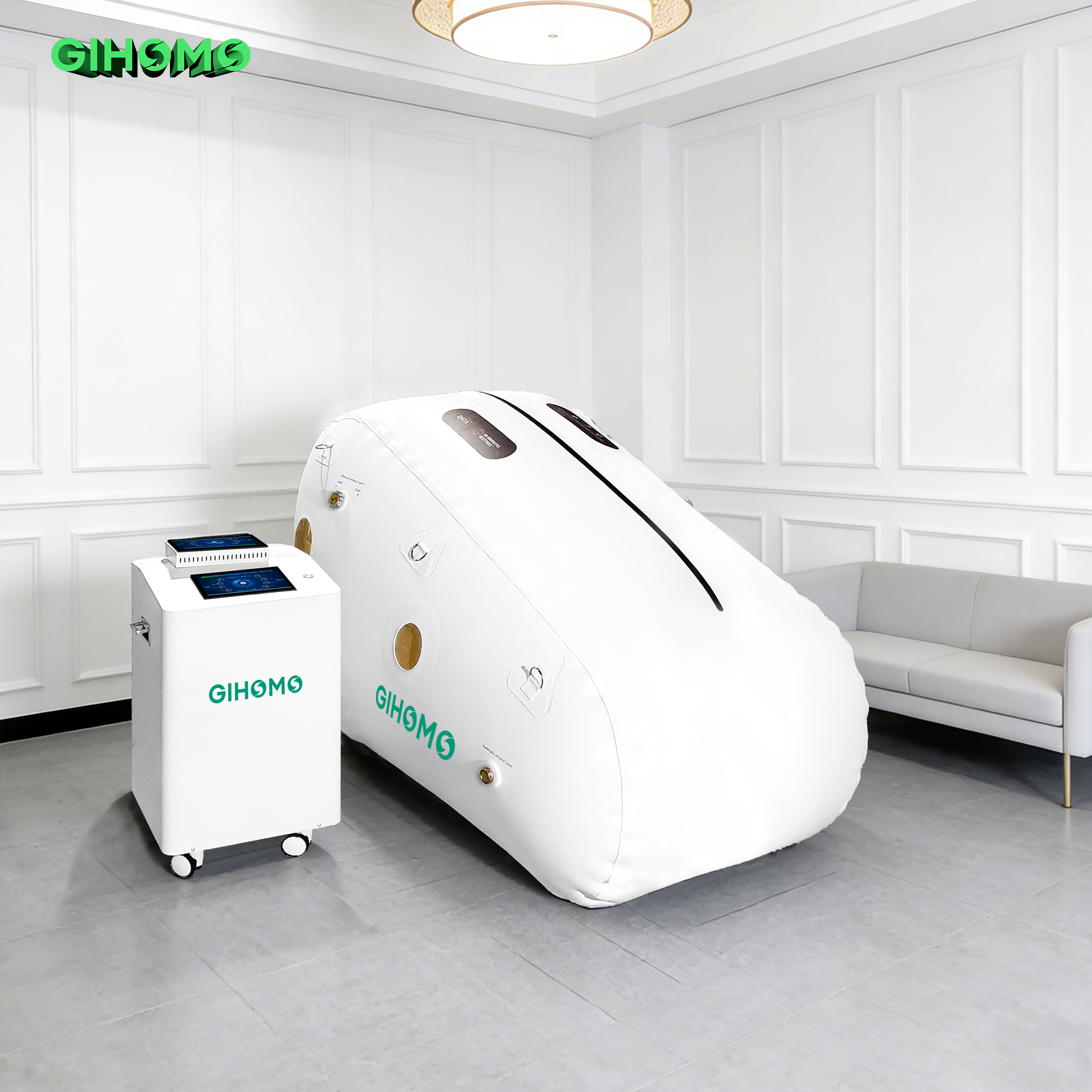
Confirm a Configuration Before You Compare Quotes
Send the five figures that matter — pressure, concentrator model, flow, purity and chamber dimensions — and GIHOMO will confirm the matching model, the certification documentation for your market, and the delivery plan for your project.
Email: gihomo@hotmail.com | Tel: +86 13118899348 | WhatsApp: +852 68176191
Website: www.gihomo.com
Address: 8th floor, Building 5, CIMC industrial park, Daliang, Shunde district, Foshan city, Guangdong province, PRC.
GUANGDONG GIHOMO MEDICAL TECHNOLOGY CO., LTD. was established in 2021, operates under an ISO9001 quality management system, and manufactures hard shell and portable hyperbaric oxygen chambers for rehabilitation, sport recovery, health care, and beauty and anti-aging applications.
Have Questions or Need More Details?
Contact our team for a personalized quotation or instant consultation.
Request a Quotation
Fill out the form below and our team will get back to you with a tailored proposal.
WhatsApp Direct Chat
Prefer to chat in real-time? Message us on WhatsApp for instant assistance & quick answers.
- Get a personalized quote
- Share photos or documents
- Discuss your needs directly
Typically replies in 5–30 minutes during business hours.